


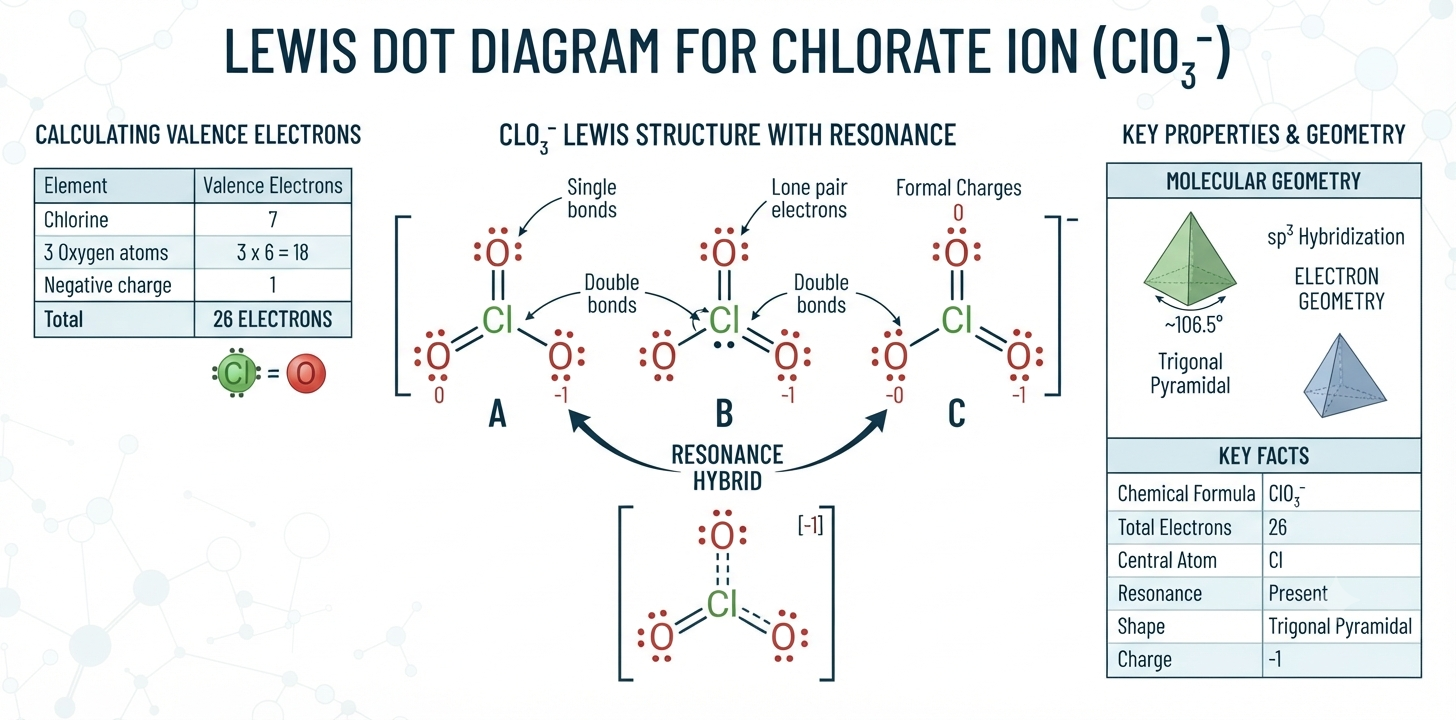
The ClO3 Lewis structure represents how valence electrons are arranged in the chlorate ion (ClO3⁻). In this structure, chlorine (Cl) is the central atom bonded to three oxygen (O) atoms. Drawing the correct Lewis structure helps explain the ion’s bonding, formal charges, molecular geometry, and overall stability. It is a fundamental concept in chemistry, especially for students learning chemical bonding, molecular structures, and resonance.
Understanding the chlorate ion is not only useful for exams but also provides a strong foundation for topics such as VSEPR theory, oxidation states, and resonance structures.
What Is the ClO3 Lewis Structure?
The ClO3 Lewis structure is a diagram that shows the arrangement of valence electrons in the chlorate ion (ClO3⁻). It illustrates how chlorine and oxygen atoms share electrons through covalent bonds while satisfying the octet rule as closely as possible.
Key facts about the chlorate ion include:
- Chemical formula: ClO3⁻
- Central atom: Chlorine (Cl)
- Surrounding atoms: Three oxygen (O) atoms
- Overall charge: −1
- Total valence electrons: 26
The final Lewis structure contains resonance forms, meaning the double bond can appear between chlorine and any one of the three oxygen atoms. These resonance structures make all Cl–O bonds equivalent in the actual ion.
Total Valence Electrons in ClO3
Before drawing the structure, count all valence electrons.
- Chlorine contributes 7 valence electrons.
- Three oxygen atoms contribute 18 valence electrons (3 × 6).
- The negative charge contributes 1 additional electron.
Total valence electrons = 7 + 18 + 1 = 26
This electron count is essential because every bond and lone pair must fit within these 26 electrons.
How to Draw ClO3 Lewis Structure
Follow these steps to draw the chlorate ion correctly.
Step 1: Count Valence Electrons
Calculate the total number of valence electrons.
- Chlorine = 7
- Oxygen = 18
- Negative charge = 1
Total = 26 electrons
Step 2: Choose the Central Atom
Chlorine is less electronegative than oxygen, so it becomes the central atom.
Arrange the atoms as:
O – Cl – O
|
O
Step 3: Form Single Bonds
Connect chlorine with each oxygen using single bonds.
Three single bonds use:
3 × 2 = 6 electrons
Remaining electrons:
26 − 6 = 20 electrons
Step 4: Complete Oxygen Octets
Distribute the remaining electrons around the oxygen atoms until each oxygen has eight electrons.
Step 5: Check the Central Atom
Place any remaining electrons on chlorine.
If formal charges are high, convert one or more lone pairs on oxygen into double bonds to reduce the formal charges and obtain a more stable Lewis structure.
Chlorate Ion Lewis Structure
The most stable chlorate ion Lewis structure contains:
- One Cl=O double bond
- Two Cl–O single bonds
- One lone pair on chlorine
- Three equivalent resonance structures
Because of resonance, the double bond is not fixed on one oxygen atom. Instead, the electron density is shared among all three oxygen atoms, making the Cl–O bonds nearly identical.
Formal Charges in ClO3
Formal charge helps determine the most stable Lewis structure.
In the preferred resonance structures:
- Chlorine has a formal charge of 0.
- One oxygen has a formal charge of 0.
- Two oxygen atoms each have a formal charge of −1.
The total formal charge equals −1, matching the charge of the chlorate ion.
Lower formal charges indicate a more stable Lewis structure.
Resonance in ClO3
Resonance is an important feature of the chlorate ion.
The double bond can be located between chlorine and any one of the three oxygen atoms.
As a result:
- Three equivalent resonance structures exist.
- Electrons are delocalized.
- All Cl–O bonds have nearly the same bond length.
- The actual structure is a resonance hybrid rather than a single Lewis structure.
Resonance increases the stability of the chlorate ion.
Molecular Geometry of ClO3
According to VSEPR theory:
- Electron geometry: Tetrahedral
- Molecular geometry: Trigonal pyramidal
The lone pair on chlorine slightly pushes the oxygen atoms downward, creating the trigonal pyramidal shape.
Bond Angle
The ideal tetrahedral bond angle is 109.5°.
Because chlorine has one lone pair, the bond angles become slightly smaller than 109.5° due to lone pair–bond pair repulsion.
Hybridization of Chlorine
The chlorine atom in ClO3⁻ is commonly described as having sp³ hybridization.
This is because the central atom has:
- Three bonding regions
- One lone pair
These four electron domains correspond to sp³ hybridization.
Is ClO3 Polar?
Yes.
The chlorate ion has a trigonal pyramidal molecular shape, and the electron distribution is not perfectly symmetrical because of the lone pair on chlorine.
As a result, the bond dipoles do not completely cancel, making the structure polar.
Common Mistakes While Drawing ClO3 Lewis Structure
Students often make these errors:
- Forgetting to add one extra electron for the negative charge.
- Using the wrong total of valence electrons.
- Choosing oxygen as the central atom.
- Ignoring resonance structures.
- Not checking formal charges.
- Violating the octet rule for oxygen atoms.
Avoiding these mistakes leads to a correct and stable Lewis structure.
Why the ClO3 Lewis Structure Is Important
Learning the ClO3 Lewis structure helps students understand:
- Covalent bonding
- Electron distribution
- Formal charge calculations
- Resonance structures
- Molecular geometry
- VSEPR theory
- Hybridization
- Chemical stability
These concepts are widely used in school chemistry, competitive exams, and higher education.
Frequently Asked Questions
How many valence electrons are present in ClO3⁻?
The chlorate ion contains 26 valence electrons.
What is the central atom in ClO3?
Chlorine is the central atom because it is less electronegative than oxygen.
Does ClO3 have resonance?
Yes. The chlorate ion has three equivalent resonance structures.
What is the molecular geometry of ClO3?
The molecular geometry is trigonal pyramidal, while the electron geometry is tetrahedral.
Also read : OnePlus Shutdown Issue: Battery, Software Ya Hardware Problem