


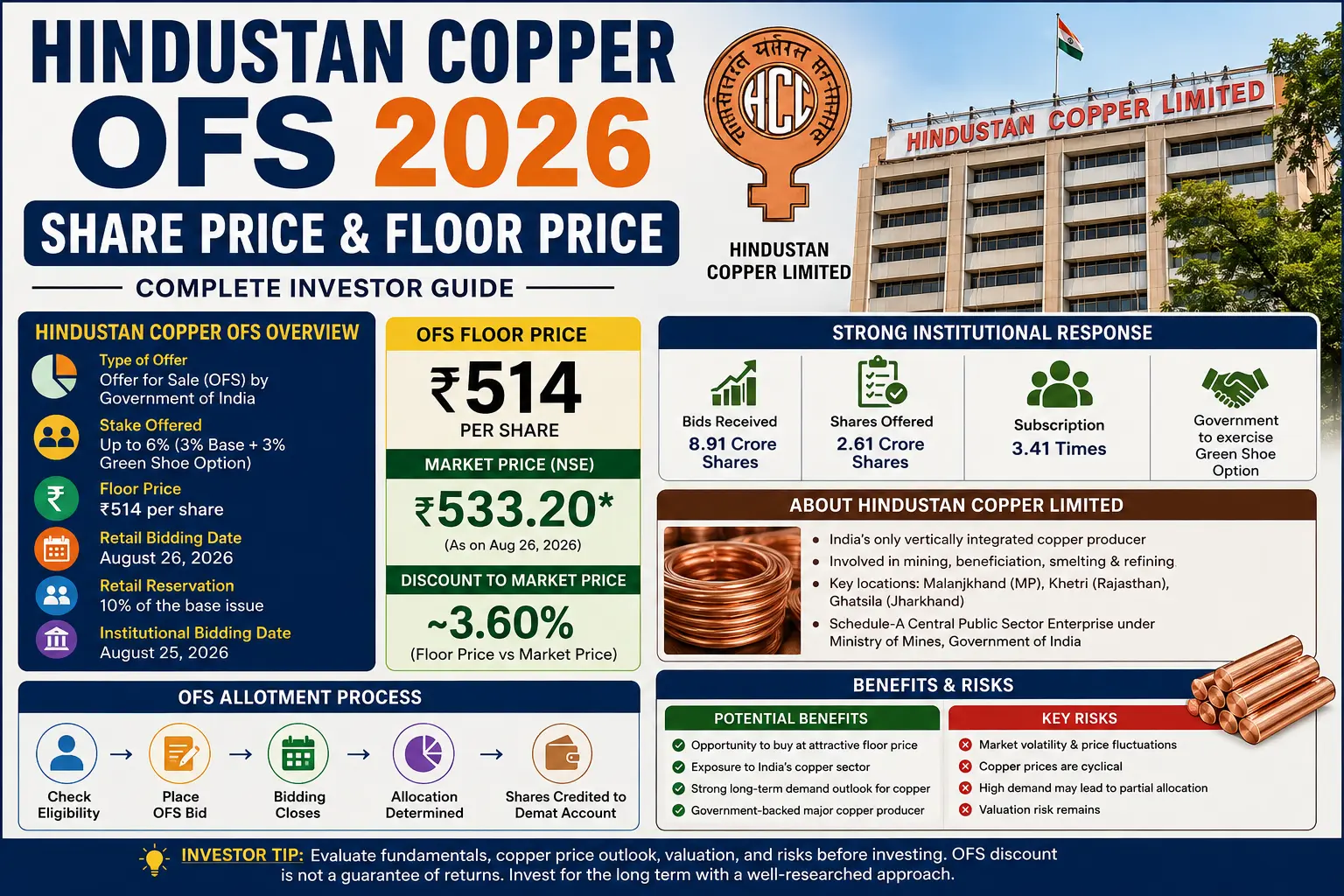
The Hindustan Copper OFS share price and floor price are among the most important factors investors are watching as the Government of India conducts an Offer for Sale in Hindustan Copper Limited. The OFS floor price has been fixed at ₹514 per share, while the company’s market price has been trading above that level, creating a visible price gap for investors to evaluate. The government initially offered a 3% stake and, after strong institutional demand, decided to exercise the additional 3% green-shoe option, taking the potential stake sale to up to 6%. The non-retail portion received bids of about 8.91 crore shares against 2.61 crore shares offered, representing subscription of around 3.41 times. Retail investors are participating in the second-day window on August 26, 2026, with 10% of the base issue reserved for the retail category.
For investors, however, the difference between the market price and the OFS floor price should not automatically be interpreted as a guaranteed return. Hindustan Copper operates in the cyclical metals industry, where copper prices, production, demand, operating performance and broader market sentiment can significantly affect the share price. The OFS therefore needs to be evaluated on both its pricing and the underlying fundamentals of the company.
What Is the Hindustan Copper OFS?
An Offer for Sale, commonly known as an OFS, is a stock-market mechanism that allows an existing shareholder to sell shares through the exchange. In this case, the seller is the Government of India, which is reducing part of its holding in Hindustan Copper Limited.
An OFS is different from a fresh issue. In a fresh issue, a company generally issues new shares and receives the proceeds. In an OFS, existing shareholders sell their shares, so the proceeds go to the selling shareholder rather than being raised directly by the company for its operations.
Hindustan Copper is a Schedule-A Central Public Sector Enterprise under the administrative control of the Ministry of Mines. The company was incorporated in 1967 and is involved in copper ore mining, beneficiation and related copper activities. Its operations include important mining assets at Malanjkhand, Khetri and Ghatsila.
The government held 66.14% of Hindustan Copper before the current stake-sale process. The proposed OFS is therefore also relevant from a public-sector disinvestment perspective because it reduces the government’s ownership while increasing the shares available to public investors.
Hindustan Copper OFS Share Price and Floor Price
The Hindustan Copper OFS share price and floor price need to be understood separately. The OFS floor price is ₹514 per share. This is the minimum price specified for the offer, rather than a promise that investors will earn a return at that price.
Before the OFS announcement, Hindustan Copper had closed at around ₹574.15 on the NSE on August 24, making the ₹514 floor price roughly 10.4% below that reference closing price. The discount attracted considerable attention, although the share price subsequently moved lower when the OFS announcement increased near-term selling pressure.
| Key OFS Factor | Current Information |
|---|---|
| Company | Hindustan Copper Limited |
| OFS type | Government Offer for Sale |
| OFS floor price | ₹514 per share |
| Base stake offered | 3% |
| Additional green-shoe option | 3% |
| Potential total stake sale | Up to 6% |
| Retail reservation | 10% of the base issue |
| Retail bidding date | August 26, 2026 |
| Institutional bidding | August 25, 2026 |
| Key consideration | Price, allocation, valuation and company fundamentals |
The important point is that investors should not simply compare ₹514 with an earlier market price and assume that the difference represents an assured gain. Market prices can move quickly during an OFS. In fact, Hindustan Copper shares fell sharply after the announcement before recovering some of the decline when retail bidding opened. On August 25, the stock closed around ₹533.20 after falling 7.04%, while on August 26 it rebounded in early trading.
For that reason, investors should treat the floor price as an entry reference rather than as an indication of guaranteed future value.
Why Is the ₹514 Floor Price Important?
The floor price matters because it establishes the minimum price for the OFS. Investors compare this level with the prevailing market price to determine whether the offer appears attractive.
When an OFS is priced below the recent market price, it can create an apparent discount. But the market can adjust rapidly once investors know that a large quantity of shares is being offered. This can reduce or even eliminate part of the apparent discount.
For example, if a stock trades close to ₹574 and the OFS floor price is ₹514, the initial difference looks meaningful. But if the market price falls toward ₹520, the effective advantage becomes much smaller. If the market price falls below the OFS price after the transaction, investors who purchased through the OFS could even face an immediate mark-to-market loss.
Therefore, the Hindustan Copper OFS share price and floor price should always be considered together with the stock’s valuation, earnings outlook and copper-market conditions.
Hindustan Copper OFS 2026 Eligibility for Retail Investors
Understanding Hindustan Copper OFS 2026 eligibility for retail investors is essential before placing a bid. The retail portion of an OFS is governed by the applicable exchange and regulatory framework, and investors need to make sure their bid is submitted under the correct category.
For this OFS, 10% of the base offer has been reserved for retail investors, while an additional 25,000 shares have been set aside for eligible employees. Retail investors are participating on August 26 following the institutional bidding session on August 25.
Investors normally need an active demat and trading account with a broker that supports OFS participation. The investor should also ensure that the order is entered under the appropriate retail category and that sufficient funds are available.
A common mistake is to assume that being eligible automatically means that the investor will receive the full quantity requested. That is not necessarily the case. When demand is high, allocation can be lower than the quantity bid for.
The strong institutional response is particularly important in this case. The non-retail segment was subscribed about 3.41 times, with 8.91 crore shares bid against 2.61 crore shares offered in the base issue. Following this demand, the government decided to exercise the full green-shoe option.
Hindustan Copper OFS Allotment Process
The Hindustan Copper OFS allotment process depends on the number of valid bids received, the number of shares available and the applicable category-specific allocation rules.
An investor can place a bid for a certain number of shares, but that does not mean the entire quantity will necessarily be allotted. When the demand is higher than the available shares, allocation can be reduced.
The process broadly involves placing an OFS bid through the broker, validating the order, closing the bidding window, determining the final allocation and settling the allotted shares into eligible investors’ demat accounts.
The final outcome is therefore different from a normal market purchase. In a normal stock-market transaction, an investor buys shares when a matching seller is available at the chosen market price. In an OFS, investors participate in a structured sale with specific rules and a defined offer period.
| Allotment Stage | What It Means for Investors |
| Check eligibility | Confirm that the investor can participate in the retail category |
| Place OFS bid | Enter the desired quantity and applicable bid price |
| Bidding closes | Exchange stops accepting new bids for the session |
| Demand is assessed | Valid bids are compared with shares available |
| Allocation is determined | Investors may receive full or partial allotment |
| Settlement | Allocated shares are credited according to the settlement process |
The high institutional demand makes allocation an important consideration. Strong subscription does not mean retail investors should automatically bid aggressively. Instead, investors should decide their desired exposure before placing an order.
How Does OFS Bidding Work?
OFS bidding is generally conducted through a broker’s trading platform. The exact interface varies from broker to broker, but investors typically need to select the OFS option, choose the company, enter the quantity and submit the order.
The investor should carefully check the price before confirming the bid. Since the OFS has a stated floor price, bids should comply with the applicable price requirements.
Another important point is that the floor price is not necessarily the final price at which every investor will receive shares. The final price and allocation depend on the OFS mechanism and valid bids.
Investors should therefore read the broker’s order information carefully rather than relying on assumptions based on regular equity trading.
Should I Apply for Hindustan Copper OFS?
The question Should I apply for Hindustan Copper OFS depends on an investor’s objectives rather than simply the discount available at the floor price.
An investor who has a long-term positive view of copper demand and Hindustan Copper’s operating outlook may consider the OFS worth evaluating. However, an investor focused only on short-term gains should be more cautious because the stock has already shown significant volatility around the announcement.
Market analysts have also cautioned investors against treating the discount as the sole reason to subscribe. The stock had recently rallied strongly, while its valuation and the outlook for metal prices remain important considerations.
The right approach is to ask several questions:
- Is ₹514 attractive compared with the company’s current valuation?
- What is the expected outlook for copper prices?
- Can Hindustan Copper increase production and profitability?
- What is the investor’s holding period?
- How much volatility can the investor tolerate?
- What happens if the market price falls below ₹514 after allotment?
- Is the investor comfortable with partial allocation?
If the answer to these questions is positive, the OFS may deserve consideration. If the investment thesis is based only on the apparent discount, the investor should reassess the decision.
Hindustan Copper OFS Investment Opportunity
The Hindustan Copper OFS investment opportunity is closely linked to the long-term outlook for copper.
Copper is widely used in electricity transmission, power infrastructure, construction, industrial equipment, renewable energy systems, electronics and electric vehicles. Increasing electrification and infrastructure investment can support structural demand for the metal.
Hindustan Copper is particularly relevant because it is a major government-owned copper mining company in India. The company states that its activities include exploration, mining and beneficiation of copper ore, with copper concentrate currently being its principal product.
Its operating footprint includes the Malanjkhand Copper Project in Madhya Pradesh, Khetri Copper Complex in Rajasthan and Indian Copper Complex in Jharkhand. It also has downstream and processing facilities in other locations.
The investment case therefore depends on more than the OFS discount. Investors need to consider whether future copper demand, production expansion and improved operational performance can justify the company’s valuation.
Hindustan Copper reported FY2025-26 profit before tax of ₹1,232.73 crore and net sales of ₹3,054.4 crore, according to the company’s profile. The company has also stated that it has consistently distributed dividends since FY2020-21.
These figures can provide useful fundamental context, but investors should also examine the latest quarterly results before making a decision.
Hindustan Copper OFS Latest News
The Hindustan Copper OFS latest news has been dominated by strong institutional demand and the government’s decision to exercise the green-shoe option.
The government initially planned to sell 3% of Hindustan Copper through the OFS, with an additional 3% available under the green-shoe option. After the institutional portion received subscription of approximately 3.41 times, the government decided to use the full additional option. This means the potential sale increased to up to 6%, or more than 5.80 crore shares.
The strong demand can be interpreted as evidence of institutional interest, but it should not be treated as a guarantee that the stock will rise. Institutional investors can have different investment objectives, time horizons and risk models.
The stock’s price movement also demonstrates the importance of separating OFS demand from market-price performance. Hindustan Copper declined sharply on August 25 after the announcement but recovered in early trading on August 26 as the retail window opened.
Investors following the OFS should therefore monitor exchange announcements, allocation information, the company’s financial results and copper-price developments.
Why Is the Government Selling Hindustan Copper Shares?
Government stake sales can serve several objectives. One major reason is disinvestment, which allows the government to monetize part of its ownership in public-sector companies.
In the Hindustan Copper transaction, the government is selling part of its existing stake rather than asking the company to issue new equity. Therefore, the transaction changes the government’s ownership percentage and increases the portion of shares held by public investors.
The government had a 66.14% stake in Hindustan Copper before the transaction. The potential 6% sale therefore represents a meaningful reduction in government ownership, although the government remains the majority shareholder after the sale.
For investors, this can have implications for public float and shareholding structure, but it does not by itself change the company’s operating fundamentals.
Hindustan Copper OFS Benefits and Risks for Investors
The Hindustan Copper OFS benefits and risks for investors should be evaluated together.
One potential benefit is the opportunity to participate at a floor price that was set below the recent market reference price. Another potential benefit is exposure to a company operating in a strategically important metal industry.
However, investors also face several risks. The first is market-price risk. A discount at the time of purchase does not protect investors from a subsequent fall in the share price.
The second is commodity-price risk. Copper prices can be influenced by global economic growth, mine supply, inventories, industrial demand, currency movements and geopolitical developments.
The third is valuation risk. Even a strong company can produce poor investment returns if investors pay too high a valuation.
The fourth is allocation risk. High demand can mean that investors receive fewer shares than they requested.
| Potential Benefit | Potential Risk |
| OFS floor price may be below recent market price | Market price can fall after allotment |
| Exposure to India’s copper sector | Copper prices are cyclical |
| Government-backed major copper producer | Valuation may remain elevated |
| Potential long-term copper demand growth | Operating performance can fluctuate |
| Retail participation opportunity | High demand may reduce allocation |
| Established mining assets | Commodity and regulatory risks remain |
This balance is important. Investors should not look at the OFS as a risk-free discount purchase.
Copper Demand and the Long-Term Investment Case
Copper’s long-term demand outlook is one of the main factors that can influence the investment thesis for Hindustan Copper.
The metal is essential for electrical infrastructure because of its conductivity and durability. Electricity grids, renewable power projects, electric vehicles, charging infrastructure and data-center development can all require significant quantities of copper.
This creates a potentially attractive structural backdrop for copper producers.
However, long-term demand growth does not automatically translate into higher shareholder returns. A company’s ability to benefit depends on production volumes, operating costs, project execution, capital expenditure, commodity prices and the valuation at which investors buy the shares.
For Hindustan Copper, expansion of mining capacity and improvement in operational efficiency are therefore important areas for investors to monitor.
Company Fundamentals Investors Should Track
Before evaluating the Hindustan Copper OFS share price and floor price, investors should examine several fundamental indicators.
Revenue growth can show whether the company’s operating scale is increasing. Profitability indicates whether higher sales are translating into stronger earnings. Production volumes help investors understand the operational side of the mining business.
Copper prices are another critical variable because the company’s earnings can be influenced by the realized prices of its products.
Investors should also monitor capital expenditure because mining expansion requires substantial investment. Higher capital expenditure may support future growth but can also affect cash flows in the short term.
Debt and liquidity should be reviewed as well. A company with a strong balance sheet may have more flexibility to fund expansion, while a heavily leveraged company may face greater financial pressure during a commodity downturn.
Is the OFS Discount Enough?
A common mistake in OFS investing is to focus exclusively on the discount.
Suppose the market price is significantly above the OFS floor price. That difference can appear attractive. But the market price itself reflects investor expectations, and it can change rapidly once the OFS becomes active.
The correct question is not simply, “How much discount am I getting?”
A better question is, “Is the company worth more than the price I am paying after considering its fundamentals, risks and future earnings?”
That distinction is especially important in a commodity company. Copper prices can rise rapidly during periods of supply constraints and strong demand, but they can also decline when global economic conditions weaken.
Therefore, the OFS price should be treated as one input in the investment decision rather than the entire investment thesis.
What Retail Investors Should Check Before Bidding
Retail investors considering the offer should create a simple checklist before placing their bids.
First, confirm the Hindustan Copper OFS 2026 eligibility for retail investors and ensure the order is being placed in the correct category.
Second, check the latest market price and compare it with ₹514.
Third, understand the possibility of partial allocation.
Fourth, review the latest financial results and company disclosures.
Fifth, consider the investment horizon. An investor planning to hold for several years should focus more on production, earnings and copper demand than on one-day price movements.
Sixth, understand the downside. If the market price falls below the OFS purchase price, the investor can incur a loss even though the shares were bought at the official floor price.
What Happens After the OFS?
After the OFS closes, investors need to monitor the allocation and settlement information.
If shares are allotted, they should appear in the investor’s demat account according to the applicable settlement schedule. If only part of the bid is allotted, the investor receives the allotted quantity rather than the full requested amount.
Investors should also watch the stock after the OFS because the market may react to the increased public share supply.
A government stake sale can temporarily create selling pressure, although the long-term impact depends on the company’s fundamentals and market demand.
The post-OFS period can therefore be just as important as the bidding period.
Key Factors That Could Affect Hindustan Copper Share Price
Several factors could influence the company’s share price after the OFS.
Copper prices: Higher copper prices can support revenue and profitability, while lower prices can pressure earnings.
Production growth: Higher mining output can improve the company’s ability to benefit from strong copper demand.
Project execution: Expansion plans need to be completed on time and within reasonable costs.
Global demand: Industrial activity in major economies can affect copper consumption.
Government ownership: Changes in government stake can affect public float and investor sentiment.
Valuation: Even strong operational performance may not support the share price if expectations are already very high.
Market sentiment: Broader movements in Indian equities and metal stocks can influence Hindustan Copper independently of its fundamentals.
Should Long-Term Investors Consider Hindustan Copper?
Long-term investors should evaluate Hindustan Copper based on the company’s potential to increase production, benefit from copper demand and generate sustainable earnings.
The company’s position in India’s copper industry provides an important strategic advantage, but investors should also recognize that mining is capital intensive and exposed to commodity cycles.
The current OFS can provide an entry opportunity, but whether that opportunity is attractive depends on the investor’s valuation framework.
Investors who already have exposure to metal stocks should also consider portfolio concentration. Buying more shares of one commodity-linked company can increase sector-specific risk.
Diversification remains important even when the underlying long-term industry outlook appears favorable.
How to Evaluate the OFS Without Chasing the Discount
A disciplined approach can help investors avoid emotional decisions.
Start with the company’s fundamentals. Review revenue, profit, production, cash flow and balance-sheet strength.
Next, evaluate the copper outlook. Consider whether current copper prices are sustainable or supported by temporary factors.
Then compare the OFS price with the company’s valuation rather than only the previous day’s share price.
Finally, determine how much capital you are willing to risk.
The strongest investment decisions generally come from combining valuation, business quality and risk assessment rather than relying on a single headline such as “10% discount.”
Hindustan Copper OFS: Important Takeaways
| Investor Question | Practical Answer |
| What is the floor price? | ₹514 per share |
| Is ₹514 a guaranteed profit price? | No |
| How much stake is being offered? | Up to 6%, including green-shoe |
| Is there retail reservation? | Yes, 10% of the base issue |
| Was institutional demand strong? | Yes, about 3.41 times the base offer |
| Can retail investors get fewer shares? | Yes, depending on demand and allocation |
| Is the OFS risk-free? | No |
| What should investors study? | Price, valuation, fundamentals, copper outlook and risks |
These points summarize the most important information, but investors should verify the latest exchange and company disclosures because OFS details can change during the process.
Hindustan Copper OFS Investment Opportunity: What Could Make It Attractive?
The Hindustan Copper OFS investment opportunity could be attractive to investors who believe India’s copper demand will remain structurally strong and that the company can expand production efficiently.
India’s ongoing investment in power infrastructure, renewable energy, transportation and industrial development can support long-term demand for copper.
Hindustan Copper’s existing mining assets and government ownership also provide strategic importance.
Nevertheless, the stock’s valuation remains critical. A good business is not automatically a good investment at every price.
Investors should therefore consider the OFS floor price alongside expected earnings, production growth and the broader copper cycle.
Final Assessment
The current Hindustan Copper OFS provides retail investors with a structured opportunity to participate in the government’s stake sale at a ₹514 floor price. The strong institutional subscription and full exercise of the green-shoe option demonstrate substantial demand for the offering. However, strong demand should not be interpreted as a guarantee of future share-price performance.
The Hindustan Copper OFS share price and floor price provide an important starting point, but the investment decision should ultimately depend on valuation, business fundamentals, copper-market conditions and individual risk tolerance.
For investors with a long-term view of copper demand, Hindustan Copper may remain an interesting company to study. For short-term investors, the recent volatility around the OFS demonstrates why the apparent discount should be approached carefully.
Inshort
The Hindustan Copper OFS share price and floor price are attracting significant investor attention because the ₹514 floor price was set below the stock’s recent market levels. The government has expanded the potential stake sale to 6% after strong institutional demand, while retail investors have a dedicated participation window. Still, the OFS does not guarantee profits, and allocation may be partial. Investors should evaluate the company’s financial performance, copper demand outlook, valuation, production plans and downside risks before making a decision. A disciplined approach based on fundamentals is more reliable than buying solely because the OFS appears discounted.
FAQs
1. What is the Hindustan Copper OFS floor price in 2026?
The Hindustan Copper OFS floor price has been fixed at ₹514 per share. It is the minimum offer price specified for the OFS and should not be interpreted as a guaranteed market value or guaranteed-return price.
2. Should I apply for Hindustan Copper OFS?
Whether you should apply depends on your investment horizon, risk tolerance, valuation assessment and view of Hindustan Copper’s long-term prospects. The discount to the previous market price can be attractive, but it does not guarantee a profit.
3. How does the Hindustan Copper OFS allotment process work?
Investors submit eligible bids during the designated OFS window. After bidding closes, shares are allocated according to the applicable rules and available supply. If demand exceeds the shares available, investors may receive only part of the quantity they requested.
4. What are the main benefits and risks of Hindustan Copper OFS?
Potential benefits include access to shares at the ₹514 floor price and exposure to India’s copper industry. Key risks include market volatility, commodity-price fluctuations, valuation risk and partial allotment. Investors should assess these factors before participating.