


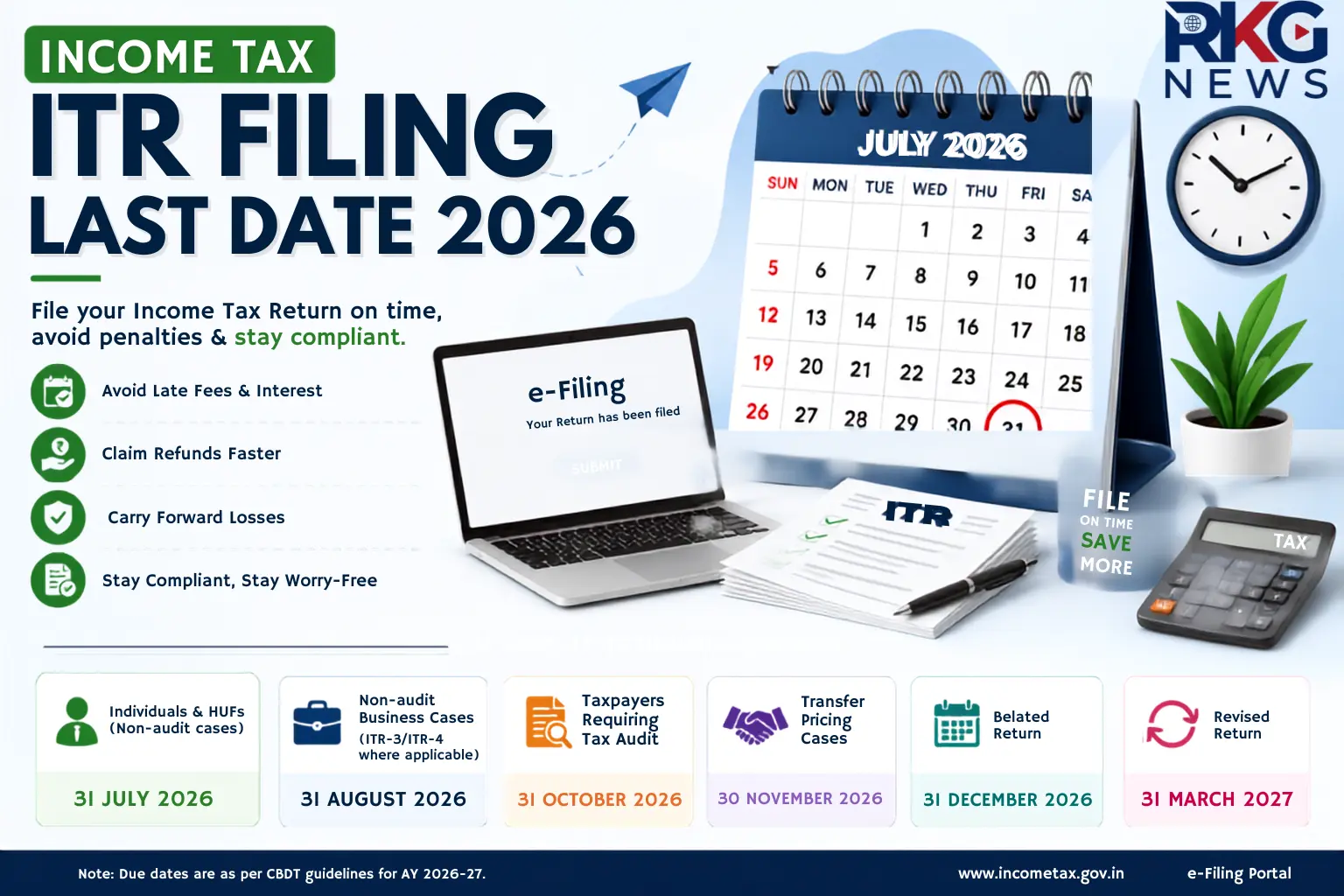
Income tax ITR filing last date your taxpayer category will determine the response to your question regarding the income tax ITR filing deadline. The deadline for the majority of salaried individuals, retirees, and taxpayers who are exempt from having their accounts audited for Assessment Year (AY) 2026–27 (Financial Year 2025–26) was July 31, 2026, and the Central Board of Direct Taxes (CBDT) did not extend it. Depending on their tax liability, taxpayers who missed this deadline may still file a delayed return, but they may be required to pay interest and a late filing charge.
Knowing the correct ITR due date is important because filing your return on time helps you avoid penalties, claim tax refunds faster, carry forward eligible losses, and maintain a clean financial record. Whether you are a salaried employee, freelancer, business owner, or investor, understanding the applicable filing deadline can save you from unnecessary legal and financial complications.
What Is the Income Tax ITR Filing Last Date?
The Income Tax Return (ITR) filing last date is the deadline prescribed by the Income Tax Department for submitting your annual income tax return. Every taxpayer must file their return before the applicable due date unless exempt under the Income-tax Act.
For AY 2026–27, the applicable due dates are:
| Taxpayer Category | Last Date |
|---|---|
| Salaried individuals, pensioners, HUFs (non-audit) | 31 July 2026 |
| Non-audit business cases (ITR-3/ITR-4 where applicable under updated provisions) | 31 August 2026 |
| Taxpayers requiring tax audit | 31 October 2026 |
| Transfer pricing cases | 30 November 2026 |
| Belated Return | 31 December 2026 |
| Revised Return | 31 March 2027 (subject to applicable law) |
Why Filing Your ITR Before the Due Date Matters
Many taxpayers assume that if no tax is payable, filing can be delayed. However, timely filing offers several important benefits:
- Avoids late filing fees.
- Prevents interest on unpaid taxes.
- Enables faster processing of tax refunds.
- Allows carry forward of eligible capital or business losses.
- Improves loan and visa application credibility.
- Maintains better tax compliance history.
Even if your employer has deducted TDS, filing your return is often necessary to claim refunds or report additional income correctly.
What Happens If You Miss the ITR Filing Last Date?
Missing the deadline does not always mean you cannot file your return, but there can be consequences.
Some possible outcomes include:
- Late filing fee under applicable provisions.
- Interest on outstanding tax liability.
- income tax ITR filing last date.
- Delay in receiving tax refunds.
- Loss of certain tax benefits.
- Inability to carry forward specific losses in many cases.
A taxpayer who misses the original deadline should generally file a belated return as soon as possible instead of waiting until the last moment.
Example
Suppose Rahul is a salaried employee.
- Annual salary: ₹11 lakh
- TDS deducted by employer: ₹85,000
- Actual tax payable after deductions: ₹72,000
Since excess TDS has already been deducted, Rahul is eligible for a refund of ₹13,000.
If Rahul files his ITR before the due date, the refund process usually starts sooner. If he delays filing unnecessarily, his refund may also get delayed.
Documents Required Before Filing ITR
Keeping your documents ready makes the filing process much easier.
Common documents include:
- PAN Card
- Aadhaar Card
- Form 16
- Salary slips
- Bank statements
- Interest certificates
- Form 26AS
- AIS (Annual Information Statement)
- income tax ITR filing last date
- TIS (Taxpayer Information Summary)
- Investment proof
- Home loan interest certificate (if applicable)
- Capital gains statements (if applicable)
Always cross-check the information available in AIS and Form 26AS before submitting your return.
How to File Income Tax Return
The filing process has become much simpler in recent years.
Step 1
Log in to the Income Tax e-Filing portal using your PAN and password.
Step 2
Select the correct Assessment Year.
Step 3
Choose the appropriate ITR form.
Step 4
Verify your personal details.
Step 5
Report all sources of income.
Step 6
Claim eligible deductions.
Step 7
Verify taxes paid using Form 26AS and AIS.
Step 8
Submit the return.
Step 9
Complete e-verification using Aadhaar OTP, net banking, bank account, or other available methods.
Your return is considered complete only after successful verification.
Choosing the Correct ITR Form
Different taxpayers must use different forms.
| Taxpayer | Common ITR Form |
|---|---|
| Salaried individual | ITR-1 or ITR-2 |
| Capital gains income | ITR-2 |
| Business or professional income | ITR-3 |
| Presumptive taxation | ITR-4 |
Choosing the wrong form may result in defects or delays during processing.
Common Mistakes Taxpayers Make
Many returns get delayed because of avoidable errors.
Some common mistakes include:
- Selecting the wrong ITR form.
- income tax ITR filing last date.
- Forgetting to report bank interest.
- Ignoring AIS or Form 26AS.
- Entering incorrect bank account details.
- Claiming deductions without eligibility.
- Not e-verifying the return.
- Waiting until the final day to file.
Reviewing every section carefully before submission helps avoid notices and corrections later.
Expert Tips for Hassle-Free ITR Filing
Tax professionals generally recommend following a few simple practices:
- File well before the deadline.
- Match every income entry with AIS.
- Keep all supporting documents safely.
- Report every income source honestly.
- Verify your return immediately after filing.
- Save the acknowledgement for future reference.
Early filing also reduces the chances of facing heavy portal traffic near the deadline.
Key Facts at a Glance
| Item | Details |
|---|---|
| Return Name | Income Tax Return (ITR) |
| Applicable Year | AY 2026–27 |
| Salaried Individual Due Date | 31 July 2026 |
| Belated Return Last Date | 31 December 2026 |
| Revised Return Last Date | 31 March 2027 |
| Filing Mode | Online through Income Tax e-Filing Portal |
Frequently Asked Questions (FAQs)
1. What is the income tax ITR filing last date for salaried employees?
For AY 2026–27, the due date for most salaried individuals and other non-audit taxpayers was 31 July 2026.
2. Can I submit my ITR after the deadline?
Indeed. Subject to the terms of the Income-tax Act and payment of any applicable late fees or interest, you may normally file a belated return before the applicable final date if you miss the initial deadline.
3. Is there a penalty for late ITR filing?
Yes. Depending on your circumstances and tax liability, late filing may attract a fee under the Income-tax Act along with interest on unpaid taxes.
4. What happens if I do not file my ITR at all?
Failure to file an applicable income tax return can lead to penalties, notices from the Income Tax Department, delayed refunds, and loss of certain tax benefits.
5. Can I revise my income tax return after filing?
Yes. If you discover an error after filing, you can submit a revised return within the prescribed time limit, provided the legal conditions are satisfied.
Also read : Gold & Silver Prices Today





Income tax can often seem confusing, especially when people are trying to understand tax filing, deductions, exemptions, deadlines, or the documents required for filing a return. Having clear and updated information can make the entire process much easier and help taxpayers avoid common mistakes. I found this discussion useful because understanding the basics of income tax is important for both salaried individuals and business owners. I have also shared some helpful information about income tax on our website, covering common questions and practical details in a simple and easy-to-understand way. Anyone looking for more information about income tax, tax-related procedures, filing requirements, deductions, or other important tax topics can visit our website and explore the available guides. It is always better to understand the applicable rules and requirements before submitting any tax-related information. A well-explained resource can save time and help people make more informed decisions while managing their tax responsibilities. Readers who are interested in learning more about income tax can check our website for additional information and useful explanations on related topics.
Digital marketing is one of the most effective ways for businesses to connect with their target audience and build a strong presence online. From SEO and content marketing to social media, email campaigns, and paid advertising, each strategy can play an important role in attracting visitors and generating potential customers. I have also shared useful information about **digital marketing** on **LetsDiskuss**, covering different concepts, strategies, and common questions in an easy-to-understand format. If you want to learn more about improving online visibility, reaching the right audience, creating better content, or understanding modern digital marketing techniques, you can visit LetsDiskuss and explore the related discussions and guides.