


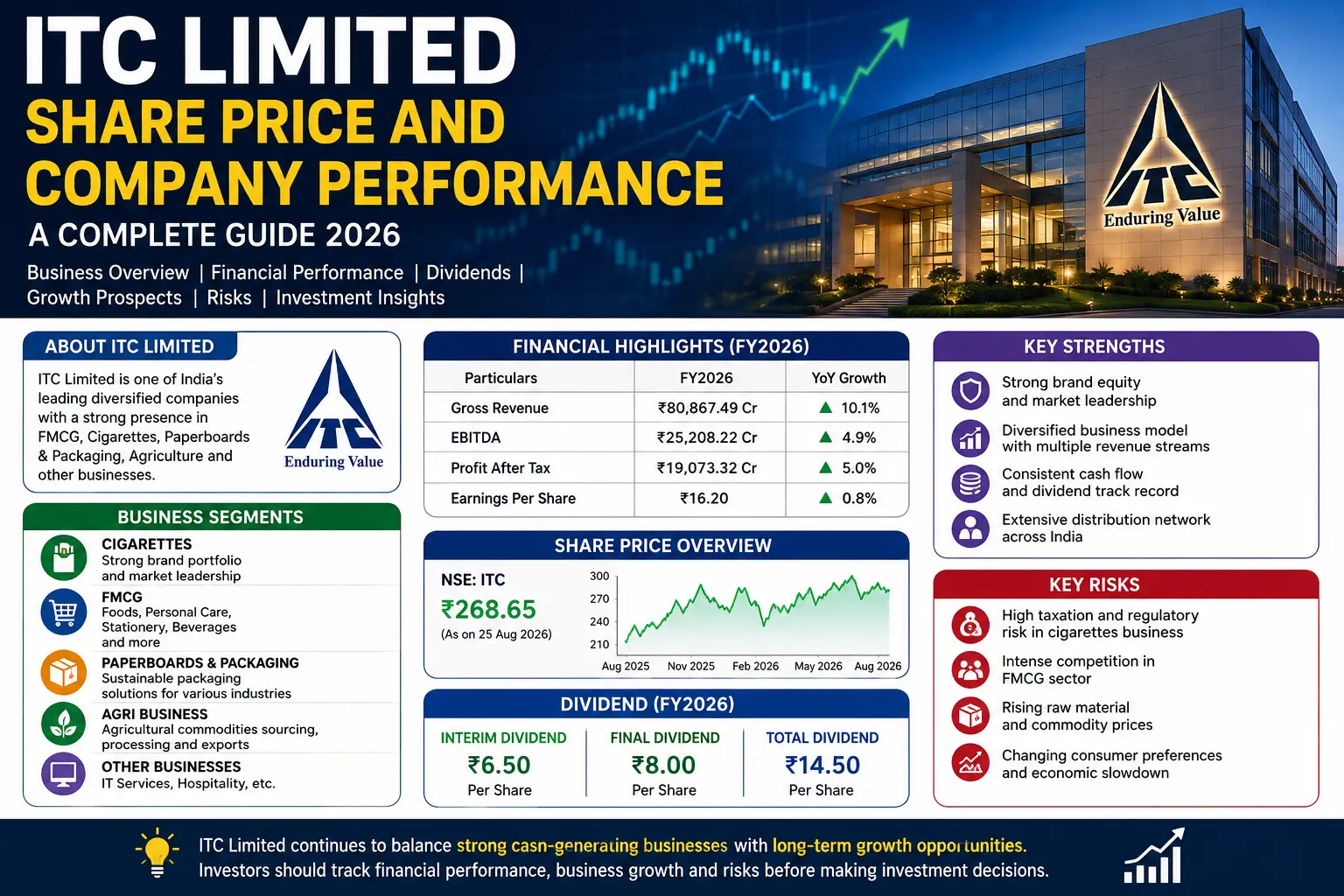
ITC Limited share price and company performance remain important topics for investors looking at one of India’s most established diversified businesses. ITC Limited operates across cigarettes, FMCG, paperboards and packaging, agriculture and other businesses, giving the company a broad earnings base. Its cigarette business remains a major profit contributor, while the FMCG business continues to be an important growth and diversification engine. In FY2026, ITC reported standalone gross revenue of ₹80,867.49 crore, up 10.1% year over year, while EBITDA increased 4.9% to ₹25,208.22 crore. The company also declared a total FY2026 dividend of ₹14.50 per ordinary share, comprising an interim dividend of ₹6.50 and a final dividend of ₹8.00.
For FY2027, the company has continued to focus on strengthening its consumer businesses, improving operational efficiency and responding to changing market conditions. In the quarter ended June 30, 2026, ITC’s FMCG segment delivered 12% year-on-year revenue growth, while segment PBIT increased 21%. However, standalone EBITDA and PAT declined year over year during the quarter, highlighting why investors should assess individual business segments rather than relying only on consolidated revenue growth.
ITC Limited Company Overview
ITC Limited is one of India’s best-known diversified companies, with a business portfolio that has evolved considerably over several decades. Although the company continues to have a strong association with cigarettes and tobacco products, its modern business structure extends into several consumer and industrial categories.
The company has developed a significant presence in packaged foods, personal care, education and stationery, dairy, beverages, paperboards, packaging and agriculture. This diversification has been a central part of ITC’s long-term strategy because it allows the company to build multiple sources of revenue while leveraging its brands, distribution network, procurement capabilities and institutional relationships.
ITC’s portfolio includes well-known consumer brands such as Aashirvaad, Sunfeast, Bingo!, YiPPee!, Classmate, Savlon and Fiama. These brands operate across different consumer categories and help the company reach customers through India’s large retail and distribution ecosystem.
Another important aspect of ITC is its ability to generate substantial cash from established businesses and allocate capital across growth opportunities, dividends, brand development and strategic investments. This makes the company relevant to both growth-oriented and income-focused investors.
ITC Business Structure at a Glance
| Business Area | Main Focus | Strategic Importance |
|---|---|---|
| Cigarettes | Tobacco and cigarette products | Major profitability contributor |
| FMCG | Foods, personal care, stationery and beverages | Long-term diversification and growth |
| Paperboards & Packaging | Paperboards, packaging and related products | Supports consumer and industrial demand |
| Agri Business | Agricultural commodities and sourcing | Supply-chain and export capabilities |
| Other Businesses | Technology and associated group operations | Diversification and service capabilities |
The business mix also means that ITC’s financial performance cannot be understood through a single metric. Cigarette volumes, FMCG demand, commodity prices, paper costs, agricultural conditions, taxation and consumer spending can all influence different parts of the company.
ITC Limited Business Model and Revenue Sources
The ITC Limited business model and revenue sources are built around a combination of high-margin consumer businesses, fast-growing FMCG categories and business-to-business operations. This structure has developed gradually as ITC expanded beyond its traditional cigarette business.
The cigarette business remains strategically important because it has historically generated strong cash flows and profitability. ITC has built a large portfolio of cigarette brands covering different consumer segments and price points. The business also benefits from established distribution capabilities and brand recognition.
At the same time, ITC has invested significantly in FMCG categories. Packaged foods, snacks, biscuits, noodles, spices, personal care products, stationery and other consumer products provide opportunities to capture India’s growing consumption market.
The paperboards and packaging business serves a different role. It supplies products used by various consumer-facing and industrial companies, including businesses involved in food, beverages and packaged goods. This segment can therefore benefit indirectly from growth in India’s consumer economy.
The agriculture business gives ITC capabilities in sourcing and handling agricultural commodities. It also supports the company’s wider supply chain and connects the business with domestic and international markets.
This diversified model creates a balance between mature cash-generating operations and businesses with higher long-term growth potential.
Key Revenue and Business Drivers
| Driver | How It Can Affect ITC |
| Cigarette volumes | Influences revenue and profitability in the core tobacco business |
| FMCG demand | Determines growth across foods, personal care and other consumer categories |
| Commodity prices | Affects margins through raw-material costs |
| Rural consumption | Can influence demand for everyday consumer products |
| Packaging demand | Supports paperboards and packaging operations |
| Agricultural conditions | Can affect sourcing, commodity availability and agri business |
| Taxation and regulation | Particularly important for cigarettes and tobacco products |
For investors, the most important point is that ITC is not simply a cigarette company. Its investment story increasingly depends on how effectively the company can combine the cash-generating strength of its established businesses with the growth potential of FMCG and other emerging operations.
ITC Limited FMCG Business and Product Portfolio
The ITC Limited FMCG business and product portfolio is one of the most important parts of the company’s diversification strategy. ITC has created a broad consumer franchise covering food, personal care, stationery, beverages and other everyday categories.
Its food portfolio includes products such as biscuits, snacks, noodles, staples, spices and dairy products. Brands including Sunfeast, Bingo!, YiPPee! and Aashirvaad provide the company with exposure to different consumer segments.
The personal care portfolio includes brands such as Fiama and Savlon, while Classmate provides a strong presence in stationery and education-related products.
This broad portfolio gives ITC the opportunity to increase its share of household consumption. India’s expanding middle class, rising urbanization, changing lifestyles, premiumization and increasing demand for branded packaged products can create long-term opportunities.
However, FMCG is also one of the most competitive sectors in India. ITC competes with large domestic companies, multinational corporations, regional brands and digital-first businesses. Winning in this environment requires continuous innovation, competitive pricing, strong distribution and effective brand building.
ITC’s latest results show that FMCG remains an important growth area. In Q1 FY2027, the standalone FMCG segment delivered 12% revenue growth year over year, with revenue excluding Staples increasing 16%. Segment PBIT increased 21%. The company also highlighted more than 20% growth in categories such as dairy, snacks, noodles and frozen snacks, along with mid-teens growth in personal care products.
FMCG Growth Areas
| FMCG Category | Examples of Opportunity | Key Growth Factor |
| Packaged Foods | Biscuits, snacks and noodles | Convenience and changing lifestyles |
| Staples | Flour, spices and related products | Household consumption |
| Dairy | Milk-based and dairy products | Growing organized consumption |
| Personal Care | Skin, hair and hygiene products | Premiumization and brand awareness |
| Stationery | Notebooks and writing products | Education and office demand |
| Beverages | Packaged consumer beverages | Urban and youth consumption |
The long-term opportunity for ITC is therefore not simply selling more products. It is about building stronger brands, increasing market share, improving margins and creating sustainable consumer franchises.
ITC Limited Financial Performance and Growth Prospects
The ITC Limited financial performance and growth prospects should be evaluated through revenue, EBITDA, profit, margins, cash generation and individual segment performance.
For FY2026, ITC reported standalone gross revenue of ₹80,867.49 crore, representing 10.1% growth over the previous year. EBITDA increased 4.9% to ₹25,208.22 crore, while earnings per share stood at ₹16.20 compared with ₹16.07 in the previous year.
The company’s Q4 FY2026 performance was also resilient. Gross revenue increased 17.5% year over year, EBITDA increased 7.3%, and profit after tax increased 5%. The company reported strong FMCG growth and continued improvement in the paper segment.
However, the June 2026 quarter demonstrates that ITC’s performance can vary significantly depending on business conditions. Standalone gross revenue increased 28% year over year, but net revenue declined 14%, while EBITDA and PAT declined 28% and 27%, respectively. The company attributed several factors to the quarter’s performance, including taxation changes affecting cigarettes and timing and disruption effects in agriculture.
This distinction between gross revenue and profitability is important. A company can report strong gross revenue growth while experiencing pressure on net revenue or margins because of taxes, input costs, business mix or other factors.
Recent Performance Indicators
| Period | Revenue / Growth Indicator | Profitability Indicator |
| FY2026 | Gross revenue ₹80,867.49 crore; +10.1% YoY | EBITDA ₹25,208.22 crore; +4.9% |
| Q4 FY2026 | Gross revenue +17.5% YoY | EBITDA +7.3%; PAT +5% |
| Q1 FY2027 | Gross revenue +28% YoY | EBITDA -28%; PAT -27% |
| Q1 FY2027 FMCG | Segment revenue +12% YoY | Segment PBIT +21% |
| Q1 FY2027 Paper | Revenue +9% YoY | Segment PBIT +38% |
These figures show why investors should examine segment-level performance. FMCG growth, cigarette taxation, paper recovery and agricultural trends can move in different directions during the same period.
ITC Limited Share Price and Company Performance
The ITC Limited share price and company performance should be considered together when evaluating the stock. The share price reflects what the market expects about future earnings, dividends, risks and valuation, rather than simply reflecting historical financial performance.
On August 25, 2026, the NSE quote for ITC showed a price of ₹268.65 during the market session captured by the exchange. Because share prices change continuously, investors should check the latest exchange quote before using a price in an article, investment decision or financial calculation.
A stock’s price alone does not indicate whether it is cheap or expensive. Investors typically compare the current market price with earnings, book value, cash generation, dividend yield and valuation multiples.
ITC can attract investors looking for a combination of established businesses, dividend income and potential long-term consumer growth. However, valuation is critical. A high-quality company can still produce disappointing investment returns if purchased at an excessive valuation.
Investors should also consider how the market values ITC after the hotels business demerger. Historical share-price comparisons need to be interpreted carefully because the corporate structure has changed.
Factors That Can Influence ITC’s Share Price
| Share Price Factor | Possible Positive Effect | Possible Negative Effect |
| Earnings growth | Can support valuation | Weak earnings can pressure price |
| Dividend | Can improve income appeal | Lower payout expectations can affect sentiment |
| FMCG growth | Supports diversification story | Weak market share can reduce optimism |
| Cigarette business | Strong cash generation | Tax and regulatory pressure |
| Input costs | Lower costs can improve margins | Inflation can reduce profitability |
| Market valuation | Re-rating can support returns | De-rating can reduce returns |
| Macroeconomy | Strong consumption can help | Slowdown can weaken demand |
Therefore, investors should avoid judging ITC solely from a short-term price movement. A more complete assessment includes earnings quality, business fundamentals, valuation and future cash-generation potential.
ITC Limited Dividend History and Future Dividend
The ITC Limited dividend history and future dividend are important for investors who value regular shareholder distributions. ITC has maintained a significant dividend-paying record, supported by the cash-generating nature of its established businesses.
For FY2026, the company declared an interim dividend of ₹6.50 per ordinary share and a final dividend of ₹8.00 per share. This resulted in a total dividend of ₹14.50 per share for the financial year, compared with ₹14.35 per share for FY2025. The final dividend was paid on July 28, 2026, to eligible shareholders based on the relevant record date.
Dividend investors should remember that historical dividend payments do not guarantee future distributions. The board considers profitability, cash flows, investment requirements, business conditions and other factors before recommending dividends.
The dividend can nevertheless be an important part of the overall investment return. For a long-term shareholder, total return may come from both capital appreciation and dividends received over time.
ITC Dividend Snapshot
| Financial Year | Interim Dividend | Final Dividend | Total Dividend |
| FY2026 | ₹6.50 | ₹8.00 | ₹14.50 |
| FY2025 | ₹6.50 | ₹7.85 | ₹14.35 |
| FY2024 | — | — | ₹13.75 |
The FY2026 dividend information is based on ITC’s official investor disclosures. Investors should always verify future dividend announcements directly through the company’s stock-exchange filings or investor-relations materials.
ITC Limited Demerger and ITC Hotels Explained
The ITC Limited demerger and ITC Hotels explained is an important part of understanding the company’s recent corporate structure.
ITC’s hotels business was demerged into ITC Hotels Limited, creating a separately listed hotels-focused company. According to ITC’s FY2025 financial-results disclosure, the hotels business demerger became effective from January 1, 2025, which was both the appointed date and effective date under the scheme.
The separation allows the hotels business to operate with a more focused corporate structure while ITC Limited can concentrate on its remaining businesses.
For shareholders and analysts, the demerger also affects historical comparisons. Older ITC financial statements included the hotels business, while future ITC Limited results reflect the post-demerger structure. Consequently, investors should make sure they are comparing like-for-like financial periods.
The change can also affect the way investors view ITC’s valuation. Before the demerger, the company was valued as a diversified group including hotels. After the separation, investors can evaluate ITC Limited and ITC Hotels Limited independently.
What the Demerger Means
| Aspect | Before Demerger | After Demerger |
| Hotels business | Part of ITC’s broader structure | Separate ITC Hotels Limited |
| ITC Limited focus | Diversified group including hotels | Core remaining businesses |
| Investor analysis | Group-level assessment | Separate company-level assessment |
| Financial comparison | Hotels included historically | Post-demerger results need adjusted interpretation |
| Strategic focus | Multiple businesses | Greater focus on ITC’s remaining portfolio |
The demerger does not mean the hotels business disappeared from the wider ITC ecosystem. Instead, it created a distinct listed entity and changed how investors should analyze the two companies.
ITC Limited Future Growth Prospects in India
The ITC Limited future growth prospects in India are closely connected to the country’s long-term consumption opportunity. India has a large and diverse consumer base, and rising incomes can increase demand for branded packaged products.
Urbanization, premiumization, digital commerce, changing lifestyles and increasing preference for convenience products can support FMCG categories. ITC’s established brands provide a foundation from which the company can expand into new product categories.
The company has also been investing in innovation and new-generation consumer businesses. Digital-first and organic portfolios have shown strong growth in recent periods, while categories such as dairy, snacks and noodles have also demonstrated momentum.
Another potential opportunity comes from distribution. ITC already has a large distribution network, and the ability to place new products through established channels can reduce some of the barriers faced by newer consumer companies.
The paperboards and packaging business can also benefit from long-term growth in packaged consumption. As more products move through organized retail and e-commerce channels, demand for packaging materials can increase.
Future Growth Drivers
| Growth Driver | Why It Matters to ITC |
| Indian consumption | Expanding consumer demand supports FMCG |
| Premiumization | Higher-value products can improve revenue mix |
| Rural growth | Provides additional market opportunities |
| E-commerce | Expands access to consumers and new brands |
| Product innovation | Helps ITC respond to changing preferences |
| Distribution | Supports faster expansion across markets |
| Packaging demand | Benefits from growth in packaged goods |
The opportunity is substantial, but growth will depend on execution. ITC must continue improving product quality, pricing, distribution, innovation and margins while responding to competition.
ITC Limited Investment Opportunities and Risks
The ITC Limited investment opportunities and risks should be considered together. The company offers several characteristics that may appeal to long-term investors, but it also operates in sectors exposed to regulation, competition and changing consumer conditions.
One major opportunity is diversification. ITC is no longer dependent on a single consumer category. The company’s FMCG portfolio provides exposure to several growing markets, while the cigarette business continues to provide substantial cash-generation capabilities.
Another opportunity is the company’s brand strength. Building consumer brands can take years, and established brands may provide competitive advantages when supported by innovation and distribution.
The dividend profile is another consideration. Investors seeking income may find ITC’s shareholder distribution policy relevant, although future payouts are never guaranteed.
At the same time, the cigarette business faces taxation and regulatory risks. Changes in tax rates, regulation, consumer behavior and illicit-trade dynamics can affect volumes and profitability.
FMCG also carries competitive risks. Companies must compete for shelf space, consumers and advertising attention. Input costs such as edible oils, wheat, cocoa, packaging materials and other commodities can also affect margins.
Investment Opportunities vs Risks
| Area | Investment Opportunity | Main Risk |
| Cigarettes | Strong brands and cash generation | Taxation and regulation |
| FMCG | Expanding Indian consumption | Intense competition |
| Dividends | Potential recurring income | Payouts are not guaranteed |
| Brand portfolio | Strong consumer recognition | Changing preferences |
| Paperboards | Packaging demand growth | Input-cost volatility |
| Agriculture | Export and sourcing opportunities | Weather and commodity cycles |
| Diversification | Multiple revenue sources | Complexity across businesses |
A balanced investment view should therefore recognize both sides. ITC’s established businesses, brands, cash generation and diversification can be strengths, while taxation, competition, input costs and valuation remain important risks.
What Investors Should Monitor in ITC
Investors following ITC should regularly review quarterly financial results, segment revenue, segment profitability, cigarette volumes, FMCG growth, operating margins and cash flows.
The company’s management commentary can also provide useful information about consumer demand, commodity prices, taxation, competitive activity and capital allocation.
For FMCG, investors should monitor whether revenue growth is translating into sustainable profitability. Strong sales growth without margin improvement may not create the same level of shareholder value as profitable growth.
For cigarettes, taxation and regulatory changes remain important variables. Investors should watch pricing actions, volumes, premiumization and the company’s ability to protect its market position.
The paperboards business should be evaluated through demand trends, capacity utilization, input costs and profitability recovery.
Investor Monitoring Checklist
| Metric / Indicator | Why Investors Should Track It |
| Revenue growth | Measures business expansion |
| EBITDA margin | Shows operating profitability |
| PAT and EPS | Important for earnings-based valuation |
| FMCG segment growth | Indicates diversification progress |
| Cigarette volumes | Reflects core business demand |
| Dividend per share | Important for income-focused investors |
| Cash flow | Indicates ability to fund dividends and investments |
| Debt and capital allocation | Helps assess financial flexibility |
ITC’s investor-relations website provides access to financial results, annual reports, stock-exchange announcements and other disclosures, making official filings an important source for keeping track of developments.
Is ITC Limited a Good Long-Term Investment?
Whether ITC is a good long-term investment depends on an investor’s objectives, entry valuation, risk tolerance and investment horizon. There is no universal answer because a stock that is attractive at one valuation may be less attractive at another.
ITC’s strengths include its established brands, diversified business model, significant cash generation, strong distribution capabilities and dividend record. The company’s FMCG expansion also gives it exposure to India’s long-term consumer growth.
However, investors should not ignore the risks. Cigarette taxation, regulatory changes, commodity inflation, competition in FMCG and fluctuations in market valuation can all affect future returns.
A long-term investor should therefore examine the latest financial results and valuation rather than relying on historical reputation alone. The company’s recent performance shows both opportunities and challenges: FMCG continues to grow strongly, while some other areas are experiencing short-term pressure.
ITC Limited: Overall Business Outlook
The overall outlook for ITC is shaped by the combination of mature cash-generating businesses and emerging growth businesses. This combination can provide stability while giving the company opportunities to participate in India’s expanding consumer economy.
FY2026 demonstrated resilience, with standalone gross revenue rising 10.1% and EBITDA increasing 4.9%. The company also maintained its shareholder distribution through a total dividend of ₹14.50 per share.
At the same time, Q1 FY2027 highlighted the importance of monitoring individual segments and external factors. FMCG performance remained strong, but overall profitability was affected by factors including changes in the cigarette taxation environment and other operating conditions.
This means the ITC investment story is not based on one single growth driver. Instead, it depends on the company’s ability to protect the profitability of established businesses while expanding FMCG, improving operational efficiency and allocating capital effectively.
Conclusion
ITC Limited continues to be one of India’s most recognizable diversified companies, with a strong combination of established brands, consumer businesses, cash-generation capabilities and a growing FMCG portfolio. The ITC Limited share price and company performance should be evaluated using current market valuation, earnings, dividends, segment performance and long-term business prospects rather than share price alone.
The company’s FY2026 performance showed resilient revenue and EBITDA growth, while the latest quarter demonstrated that taxation, commodity conditions and business-specific factors can create short-term volatility. Its FMCG business remains a key growth opportunity, supported by India’s expanding consumer market, while the cigarette business continues to be strategically important.
The demerger of the hotels business has also changed ITC’s corporate structure and should be considered when comparing historical and current financial information. Overall, ITC offers a combination of mature cash-generating businesses and long-term diversification opportunities, but investors should carefully consider valuation, regulation, competition and market risks before making an investment decision.
FAQs
1. What does ITC Limited do?
ITC Limited operates across several business areas, including cigarettes, FMCG products, paperboards and packaging, agriculture and other related businesses. Its portfolio includes major consumer brands such as Aashirvaad, Sunfeast, Bingo!, YiPPee!, Classmate, Savlon and Fiama.
2. What is the main factor affecting ITC’s share price?
ITC’s share price can be influenced by earnings growth, cigarette taxation and regulation, FMCG performance, dividend expectations, market valuation, input costs and overall investor sentiment. Therefore, investors should consider multiple factors rather than relying on a single price target.
3. How much dividend did ITC pay for FY2026?
For FY2026, ITC declared a total dividend of ₹14.50 per ordinary share, consisting of an interim dividend of ₹6.50 and a final dividend of ₹8.00. The company’s official investor information confirms that the final dividend was paid in July 2026.
4. What happened to ITC Hotels after the demerger?
ITC’s hotels business was separated into ITC Hotels Limited through a demerger that became effective from January 1, 2025. This created a separately listed hotels business and means investors should analyze ITC Limited and ITC Hotels Limited separately when reviewing current performance.