

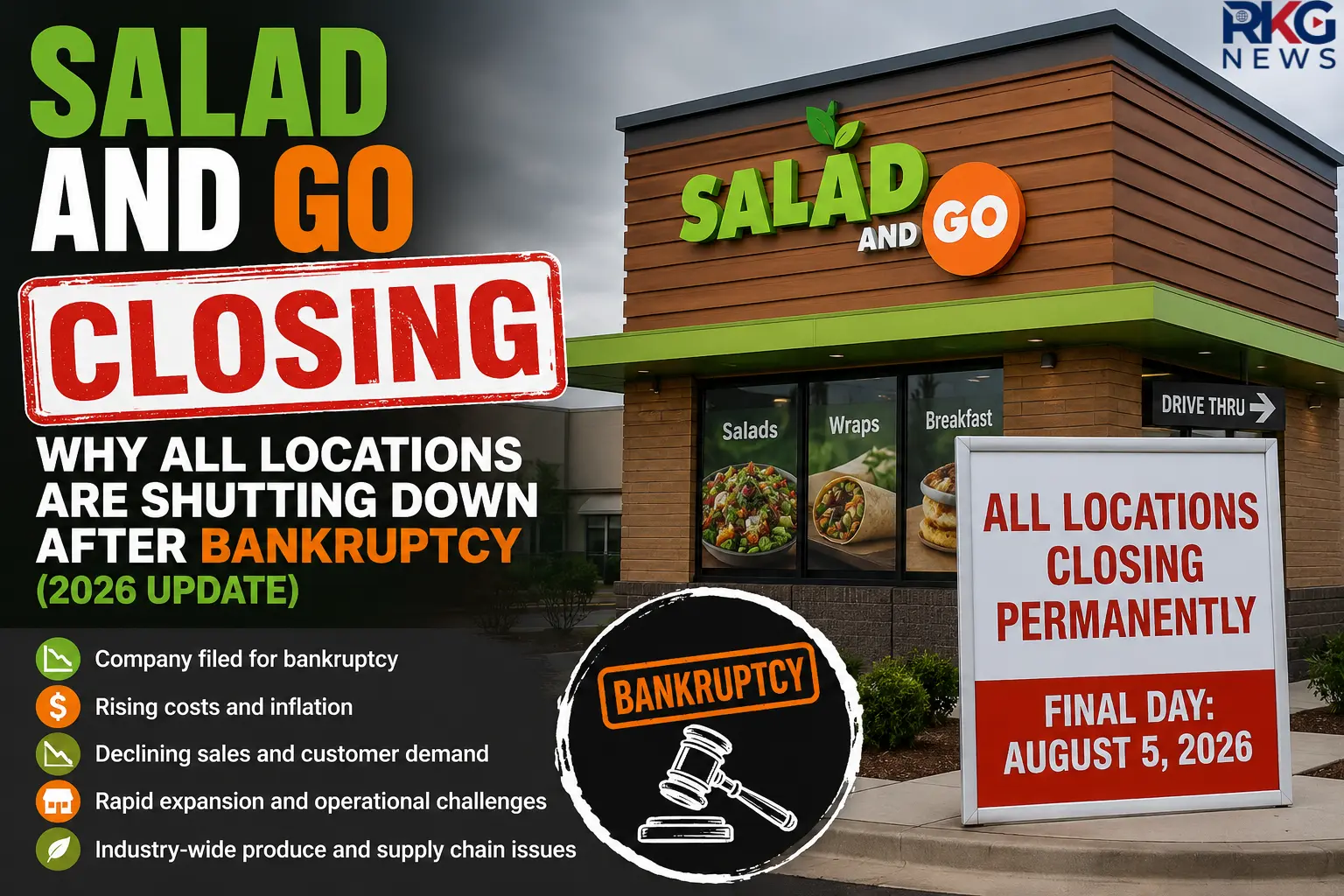
Salad And Go closing all locations permanently following its formal Chapter 11 bankruptcy filing in 2026. The drive-thru fast-casual chain—famous for offering low-cost gourmet salads, wraps, and breakfast items—has initiated a full shutdown of its store network across Arizona, Texas, Oklahoma, Nevada, and surrounding regions.
After months of struggling with compressed profit margins, soaring labor and ingredient costs, and aggressive debt obligations from rapid regional expansion, the executive leadership team determined that continued operations were no longer viable. While initial restructuring efforts under Chapter 11 aimed to save core profit-generating hubs, severe liquidity constraints ultimately forced the company to transition toward complete asset liquidation and total store closures.
All physical drive-thru locations, digital ordering portals, mobile apps, and third-party delivery partnerships are systematically winding down operations. Customers holding active gift cards or unredeemed loyalty rewards are advised to submit claims through the court-appointed bankruptcy administrator, as physical locations will no longer accept orders or honor digital balances once final store liquidations conclude.
What Happened to Salad And Go closing in 2026?
The Salad And Go bankruptcy filing explained in 2026 represents one of the most significant disruption stories in the fast-casual dining sector. Founded in Gilbert, Arizona, with a mission to make fresh, healthy food as affordable and convenient as traditional fast food, the brand disrupted the market by serving massive $7 salads through small-footprint drive-thru stalls.
However, the aggressive growth trajectory required heavy capital expenditure. Below is a structured timeline detailing how the business shifted from rapid scaling to an inevitable nationwide shutdown:
+-------------------------------------------------------------------------------+
|                        SALAD AND GO SHUTDOWN TIMELINE                         |
+-------------------------------------------------------------------------------+
|  Late 2024 – 2025  : Rapid multi-state expansion pushes total footprint past   |
|                      130+ locations; debt begins accumulating rapidly.       |
|                                                                               |
|  Early 2026        : Rising ingredient costs & labor inflation erode slim   |
|                      margins; emergency financing talks collapse.             |
|                                                                               |
|  Mid 2026          : Official Chapter 11 Bankruptcy filing announced; store   |
|                      closures begin across secondary markets.                 |
|                                                                               |
|  Late 2026 (Current): Full transition to asset liquidation; all remaining stores|
|                      close permanently.                                       |
+-------------------------------------------------------------------------------+
The Breakdown of Restructuring Efforts
Initially, court filings indicated that Salad And Go closing attempted a traditional Chapter 11 restructuring. The primary goal was to close underperforming drive-thrus, renegotiate commercial real estate leases, and secure debtor-in-possession (DIP) financing to maintain operations at core high-volume units.
Unfortunately, key lenders and equity partners declined to extend additional credit facilities without evidence of immediate margin stabilization. With operating cash flows turning severely negative and vendor defaults mounting, court approval was granted to convert the restructuring process into an orderly wind-down of all corporate operations.
Salad And Go Bankruptcy & Closure Data Overview
The following key facts table summarizes the vital statistics surrounding the Salad And Go Chapter 11 bankruptcy news and total store shutdown:
| Metric / Aspect | Corporate Status & Details |
| Parent Company / Brand | Salad And Go closing (Operating Entity) |
| Primary Business Model | Small-Footprint, Drive-Thru Only Fast-Casual |
| Bankruptcy Status | Chapter 11 Restructuring transitioning to Liquidation |
| Impacted Locations | 100% of store footprint (130+ locations) |
| Key States Affected | Arizona, Texas, Oklahoma, Nevada |
| Primary Closure Drivers | Inflationary cost pressure, razor-thin margins, over-expansion debt |
| Mobile App & Loyalty Program | Disabled / Terminated |
| Gift Card Redemption | Subject to Bankruptcy Court Claims Process |
Key Reasons Behind the Salad And Go Shutdown
Understanding the Salad And Go shutdown reason requires analyzing the broader economic pressures facing value-oriented fast-casual restaurant chains. While customers loved the affordable menu pricing, the internal economics of operating micro-locations could not withstand macroeconomic shifts.
                  +-----------------------------------+
                  |  SALAD AND GO SHUTDOWN DRIVERS   |
                  +-----------------------------------+
                                    |
        +---------------------------+---------------------------+
        |                           |                           |
        v                           v                           v
+---------------+           +---------------+           +---------------+
| Razor-Thin    |           | Unmanageable  |           | Inflation &   |
| Unit Margins  |           | Expansion     |           | Supply Costs  |
| Breakdown     |           | Debt          |           | Pressure      |
+---------------+           +---------------+           +---------------+
1. The Breakdown of the Razor-Thin Margin Model
Salad And Go closing operated on an aggressively low price point, often selling premium salads for $7 to $8 when competitors like Sweetgreen or CAVA charged $13 to $16. To make this financial model work, the company relied on high volume and extremely low overhead:
-
Micro-Footprints: Outlets were built on tiny land plots (often 600 to 800 square feet) with no indoor seating.
-
Centralized Kitchens: Fresh produce was processed in regional hub prep kitchens and delivered daily to drive-thru stalls.
While this structure kept overhead minimal during stable economic conditions, it left zero safety margin for cost inflation. When fresh produce costs, packaging materials, and freight rates surged, the company could not absorb the losses without raising prices so significantly that it would undermine its core marketing promise.
2. Over-Expansion and Debt Accumulation
Between 2022 and 2025, the brand expanded aggressively outside its home state of Arizona, entering major metropolitan markets in Texas and Oklahoma. Opening dozens of new drive-thru sites within short timeframes required substantial debt financing and upfront capital commitments.
When newly opened locations in secondary markets failed to reach maturity volume fast enough to cover debt service costs, cash reserves were quickly drained. The high fixed cost of maintaining centralized prep kitchens in under-penetrated markets further accelerated corporate burn rates.
3. Supply Chain and Produce Price Volatility
Unlike traditional fast-food chains relying heavily on frozen inventory, Salad And Go closing relied almost entirely on fresh whole produce, high-grade chicken, and perishable dairy.
-
Severe weather disruptions in major agricultural hubs pushed produce spot prices to record highs.
-
Cold-chain logistics costs increased significantly due to higher fuel and freight charges.
-
Short shelf-life meant inventory shrinkage (spoilage) drastically impacted store-level profitability.
4. Labor Cost Inflation
Operating a high-speed double drive-thru requires efficient, well-staffed teams inside small operational spaces. Rising state minimum wage thresholds and competitive local hourly pay rates across Sunbelt markets drastically increased store-level labor expenditure percentage relative to total revenue.
Impact on Customers, Employees, and Local Markets
The Salad And Go all locations closed decision carries immediate consequences for employees, loyal customers, and retail commercial real estate markets.
+-----------------------------------------------------------------------------------+
|                           IMPACT OF NATIONWIDE CLOSURE                            |
+-----------------------------------------------------------------------------------+
| CUSTOMERS          | Digital ordering offline; gift cards & rewards claims        |
|                    | directed to court bankruptcy portal.                         |
+--------------------+--------------------------------------------------------------+
| EMPLOYEES          | Store-level and corporate workforce reduction without long-   |
|                    | term severance guarantees.                                   |
+--------------------+--------------------------------------------------------------+
| REAL ESTATE        | Hundreds of prime 600-800 sq. ft. drive-thru pads entering     |
|                    | commercial sublease/auction markets.                         |
+-----------------------------------------------------------------------------------+
1. Customer Loyalty, App Services, and Gift Cards
With all stores shutting down, the official Salad And Go closing mobile app and online ordering engine have been taken offline.
-
Gift Cards & Account Balances: Gift cards cannot be redeemed for cash at physical outlets. Customers with substantial unused gift card balances must file an unsecured claim with the court-appointed bankruptcy trustee.
-
Loyalty Points: Reward balances and accrued points have been voided under the bankruptcy filing terms without financial compensation.
2. Store Employees and Corporate Workforce
The shutdown impacts thousands of store-level team members, shift managers, prep kitchen operators, and corporate staff. Because the company moved into full asset liquidation, severance packages are strictly constrained by remaining liquid assets under court-ordered distribution priority rules.
3. Vacant Drive-Thru Real Estate
Salad And Go was an early pioneer of hyper-compact drive-thru real estate pads. The sudden vacancy of over 130 drive-thru locations presents both a challenge and an opportunity for competing quick-service restaurant (QSR) brands:
-
Competitors specializing in coffee, drive-thru beverages, and single-item food concepts are actively evaluating these sites for potential lease acquisition.
-
Landlords face temporary vacancy gaps while navigating bankruptcy lease rejection procedures in court.
Common Misconceptions & Mistakes About the Closure
When high-profile restaurant brands shut down, rumors and incorrect information circulate rapidly online. Below are key clarifications regarding the Salad And Go closure full details:
Misconception 1: “Salad And Go closing was bought out by a major fast-food conglomerate.” > Fact: No corporate acquisition occurred. The company filed for Chapter 11 bankruptcy relief and subsequently initiated an independent liquidation of company-owned assets.
Misconception 2: “Only unprofitable suburban locations are closing.” > Fact: The shutdown applies across the entire corporate footprint. All locations—including high-volume flagship units in Arizona—are closing permanently.
Misconception 3: “Quality control issues or food safety outbreaks caused the bankruptcy.” > Fact: The closure was driven purely by economic factors: unsustainable expansion debt, razor-thin unit economics, supply chain cost inflation, and liquidity exhaustion.
Strategic Industry Lessons: What QSRs Can Learn
The fall of Salad And Go offers critical strategic lessons for the broader fast-casual and quick-service restaurant industry:
-
Low Price Points Require Massive Scale and Stability: Offering restaurant-quality salads at fast-food prices is viable only when supply chain costs remain ultra-stable and volume remains extraordinarily high across every single unit.
-
Expansion Must Match Regional Hub Density: Opening micro-locations far away from established central processing kitchens creates severe logistics overhead that undermines thin operating margins.
-
Debt-Fueled Growth in High-Interest Environments is Dangerous: Relying heavily on variable debt or expensive venture credit during period of rising interest rates leaves zero margin for error when unit performance dips.
5 Frequently Asked Questions (FAQs)
1. Is Salad And Go permanently closed across all states?
Yes, Salad And Go closing all store locations across Arizona, Texas, Oklahoma, Nevada, and all other operational markets. The brand is executing a complete wind-down of operations following its bankruptcy proceedings.
2. Why did Salad And Go file for Chapter 11 bankruptcy in 2026?
The company filed for Chapter 11 bankruptcy due to an unsustainable debt load incurred during rapid multi-state expansion, severe inflation in fresh ingredient and labor costs, and compressed profit margins that made store operations financially unviable.
3. Can I still use my Salad And Go gift cards or reward points?
No. Physical locations are no longer accepting gift cards or loyalty reward redemptions. Gift card holders are classified as general unsecured creditors and must submit a claim form through the court-appointed bankruptcy administrator to seek recovery.
4. What will happen to the Salad And Go drive-thru locations?
The leases for drive-thru real estate pads are being rejected or auctioned off as part of the bankruptcy court proceedings. Other fast-casual and beverage chains (such as drive-thru coffee and beverage brands) are expected to acquire these small-footprint locations.
5. Will Salad And Go return under new management or acquisition?
While it is theoretically possible for a third-party investor or private equity firm to purchase the brand’s intellectual property (IP) and trademarks at auction, there are currently no approved plans to restart store operations under new ownership.
Also read : Types of Window Blinds Different Styles and Their Benefits