

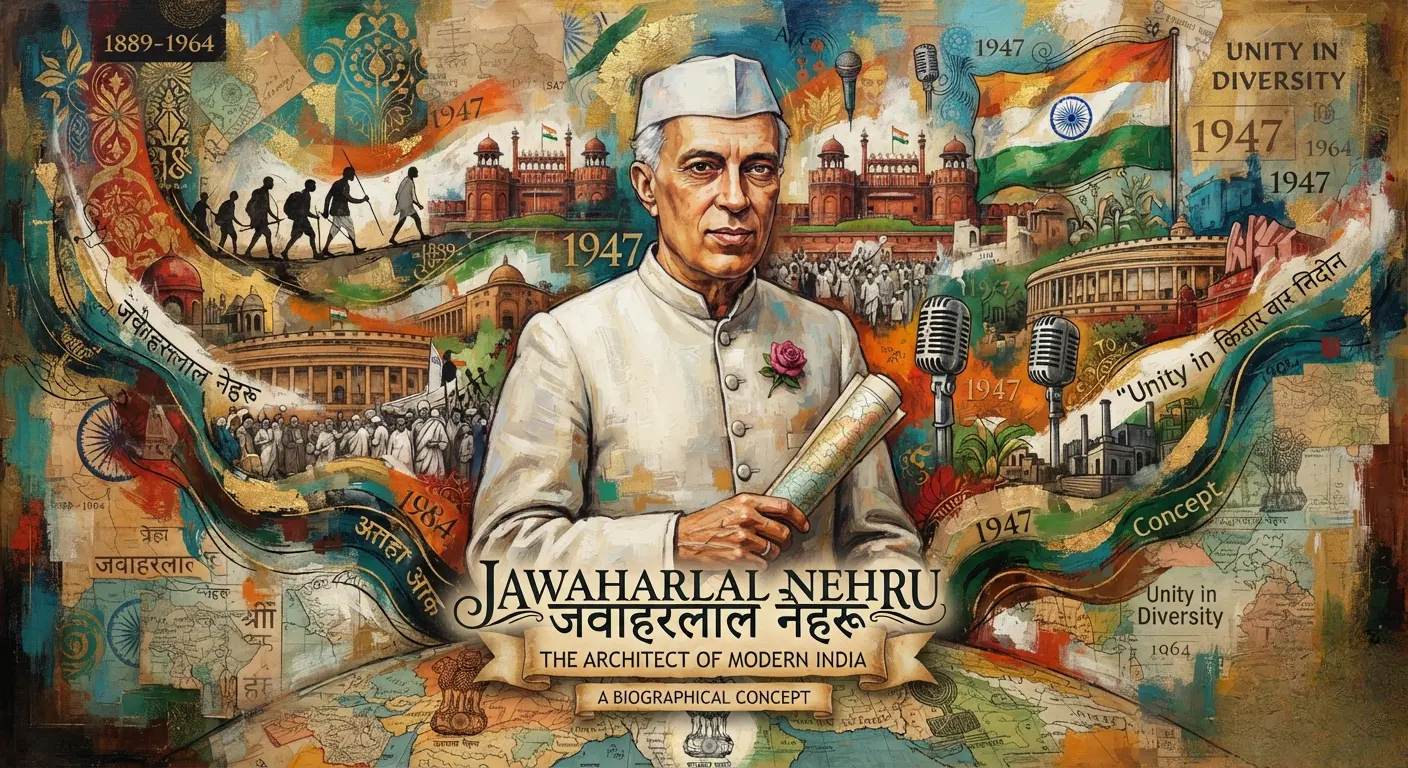
Jawaharlal Nehru Biography and Life History is an important topic for understanding India’s freedom struggle, the birth of independent India, and the development of its early democratic institutions. Jawaharlal Nehru was born on November 14, 1889, in Allahabad and became one of the leading figures of the Indian independence movement. He served as the first Prime Minister of independent India from August 15, 1947, until his death on May 27, 1964. During his nearly seventeen-year tenure, he focused on democracy, economic planning, industrialization, scientific development, education, and an independent foreign policy. His political career, writings, achievements, and controversies continue to make him one of the most studied personalities in modern Indian history.
Jawaharlal Nehru Biography and Life History: Quick Facts
The following table provides a quick overview of the most important facts associated with Jawaharlal Nehru Biography and Life History.
| Category | Information |
|---|---|
| Full Name | Jawaharlal Nehru |
| Popular Name | Pandit Jawaharlal Nehru |
| Born | November 14, 1889 |
| Birthplace | Allahabad, British India |
| Father | Motilal Nehru |
| Mother | Swarup Rani Nehru |
| Wife | Kamala Nehru |
| Daughter | Indira Gandhi |
| Education | Harrow, Trinity College, Cambridge, Inner Temple |
| Political Party | Indian National Congress |
| Position | First Prime Minister of India |
| Prime Ministerial Tenure | August 15, 1947 – May 27, 1964 |
| Major Works | The Discovery of India, An Autobiography, Glimpses of World History |
| Major Ideas | Democracy, secularism, scientific development, planning and non-alignment |
| Died | May 27, 1964 |
Early Life and Family Background
The story of Jawaharlal Nehru Biography and Life History begins in Allahabad, where Jawaharlal Nehru was born into a prominent Kashmiri Brahmin family on November 14, 1889. His father, Motilal Nehru, was a successful lawyer and an important leader of the Indian National Congress. His mother, Swarup Rani Nehru, came from a respected family and played an important role in the Nehru household.
Nehru grew up in an educated and financially comfortable environment. Unlike many children in colonial India, he had access to private tutors and an extensive home education. His childhood environment exposed him to books, political discussions, Indian culture, and developments taking place outside India.
His privileged background did not prevent him from becoming involved in the national movement. As he grew older, his understanding of British colonial rule changed considerably. His education abroad and later experiences in India helped him develop a political outlook that combined Indian nationalism with international ideas.
The family itself later became strongly associated with India’s political history. Motilal Nehru was active in the freedom movement, while Jawaharlal’s daughter Indira Gandhi later became Prime Minister of India.
Jawaharlal Nehru Early Life and Education
Education played an important role in shaping Nehru’s intellectual development. As part of Jawaharlal Nehru early life and education, he spent several important years in Britain. He attended Harrow School, one of England’s well-known public schools, before entering Trinity College, Cambridge, where he studied Natural Sciences.
After Cambridge, Nehru studied law at the Inner Temple in London. He was called to the Bar and returned to India in 1912.
His years in England exposed him to European political thought, literature, science, nationalism, socialism, and international affairs. These experiences influenced his later understanding of politics and economics.
However, his worldview was not formed entirely in Britain. His experiences after returning to India were equally important. He witnessed the realities of colonial society and gradually became more involved in political activities.
Nehru’s education helped him develop an international perspective that later influenced his approach to foreign policy. He believed India should become modern and scientifically advanced while retaining its own cultural identity.
Entry Into Indian Politics
After returning to India, Nehru initially worked as a lawyer but soon became increasingly interested in national politics. His political involvement grew during the second decade of the twentieth century.
A major turning point came when he met Mahatma Gandhi. Gandhi’s philosophy of non-violent resistance and mass political mobilization had a significant influence on Nehru’s political career.
Although Gandhi and Nehru had differences in their views on economics, industrialization, modernity, and political strategy, they worked together within the Indian National Congress. Nehru increasingly became one of the prominent younger leaders of the organization.
His political outlook was also influenced by events occurring around the world. He followed anti-colonial movements in Asia and Africa and became interested in socialist ideas and the struggle against imperialism.
This combination of nationalism and internationalism became a defining feature of his political identity.
Jawaharlal Nehru Role in Indian Independence
The Jawaharlal Nehru role in Indian independence developed over several decades and included political organization, public demonstrations, Congress leadership, imprisonment, and participation in major national movements.
Nehru became closely involved with the Indian National Congress and supported the demand for complete independence from British rule. He participated in several movements organized against colonial rule and was arrested multiple times.
In 1929, Nehru became president of the Lahore session of the Indian National Congress. The session was historically significant because the Congress adopted Purna Swaraj, meaning complete independence, as its political objective.
January 26, 1930, was subsequently observed as Independence Day by the national movement. The date later became constitutionally significant because January 26 was chosen as the date when India’s Constitution came into effect in 1950.
Nehru’s leadership during this period helped connect the Congress with younger Indians who wanted complete independence rather than limited political reforms under British authority.
Major Stages of Nehru’s Freedom Struggle
| Period | Major Development | Historical Importance |
| 1910s | Increasing involvement in Congress politics | Beginning of his active political career |
| 1916 | Meeting with Mahatma Gandhi | Important influence on his political development |
| 1920s | Participation in nationalist movements | Greater involvement in mass politics |
| 1929 | Congress presidency at Lahore | Purna Swaraj became the Congress objective |
| 1930s | Civil Disobedience activities and imprisonment | Strengthened his role in the freedom movement |
| 1942 | Quit India Movement period | Further confrontation with British rule |
| 1947 | Independence of India | Nehru became India’s first Prime Minister |
Participation in the Freedom Movement
One of the most important aspects of Jawaharlal Nehru Biography and Life History is his repeated participation in the freedom struggle. He spent considerable periods in British prisons because of his involvement in nationalist activities.
Nehru’s imprisonment was a major personal sacrifice, but it also gave him time for reading, reflection, and writing. His political thinking became more developed during these periods.
He participated in the Non-Cooperation Movement, the Civil Disobedience Movement, and later the Quit India Movement. His repeated arrests demonstrated his commitment to the independence cause.
His political relationship with Gandhi was particularly important. Gandhi was the senior leader of the national movement, while Nehru represented a younger generation with strong interests in science, socialism, industrialization, and international affairs.
Despite differences, they remained important political partners. Nehru’s ability to work within the Congress while maintaining his own intellectual identity contributed to his rise as a national leader.
Nehru as Congress President
Nehru served as president of the Indian National Congress on several occasions. His first major presidency came at the Lahore session in 1929, which became a turning point in India’s freedom movement.
The Congress under Nehru’s leadership moved toward a clear demand for complete independence. This was important because the national movement was increasingly shifting away from demands for limited self-government toward full sovereignty.
His political importance continued to increase during the 1930s and 1940s. He became one of the central figures in negotiations and political discussions concerning India’s future.
By the time India approached independence, Nehru was already one of the most prominent leaders of the Congress and a key figure in determining the political direction of the country.
Jawaharlal Nehru as the First Prime Minister of India
A central part of Jawaharlal Nehru Biography and Life History is his role as the first Prime Minister of independent India. On August 15, 1947, India became independent from British rule, and Nehru assumed office as Prime Minister.
His famous “Tryst with Destiny” speech delivered around independence became one of the best-known speeches in Indian political history. It reflected the importance of the moment and the enormous responsibilities facing the new country.
Nehru inherited a nation dealing with the consequences of Partition, large-scale displacement, communal violence, poverty, low literacy, weak industrial infrastructure, and the challenge of integrating a diverse population into a functioning democracy.
The first years of independence were therefore focused not only on political freedom but also on nation-building.
Major Priorities During Nehru’s Premiership
| Area | Nehru’s General Approach | Long-Term Significance |
| Democracy | Parliamentary government and constitutional institutions | Strengthened India’s democratic framework |
| Economy | Planning and public-sector development | Built an industrial and infrastructure base |
| Science | Scientific research and technical education | Expanded India’s scientific capabilities |
| Education | Higher education and technical institutions | Developed skilled human resources |
| Foreign Policy | Non-alignment and strategic independence | Established an independent diplomatic identity |
| Industry | Focus on heavy industries and infrastructure | Supported long-term industrialization |
| Society | Secular and inclusive political framework | Addressed India’s religious and cultural diversity |
Building India’s Democratic Institutions
After independence, one of Nehru’s most significant responsibilities was helping establish a stable democratic system. India adopted a parliamentary form of government under its Constitution in 1950.
Nehru worked within the constitutional framework and participated in the country’s first general elections in 1951–52. These elections were a remarkable democratic exercise because India had a huge population, widespread poverty, and relatively low literacy.
The successful conduct of democratic elections became an important part of India’s early political development.
Nehru’s government also operated through Parliament, elections, ministries, courts, civil services, and other institutions. His long tenure provided political continuity during the formative years of the Republic.
The survival and consolidation of parliamentary democracy in India became one of the major features associated with his early leadership.
Economic Development and Five-Year Plans
The Jawaharlal Nehru political career and achievements also included a strong focus on economic planning. Nehru believed that India needed rapid economic development to overcome poverty and colonial underdevelopment.
The government adopted a mixed economic model in which both the public and private sectors had roles, but the state played a particularly important part in heavy industry, infrastructure, energy, and strategic sectors.
The Planning Commission became a central institution for economic planning. India implemented a series of Five-Year Plans to organize investment and development priorities.
The First Five-Year Plan, launched in 1951, placed considerable emphasis on agriculture, irrigation, and rural development. Later plans increasingly focused on industrialization and heavy industry.
Nehru believed that large public-sector projects could provide the foundation for India’s long-term economic transformation.
Economic Development Under Nehru
| Development Area | Main Focus | Intended Objective |
| Agriculture | Irrigation and rural development | Improve food production |
| Heavy Industry | Steel and engineering | Build industrial capacity |
| Infrastructure | Dams, power and transport | Support economic growth |
| Public Sector | Strategic industries | Reduce external dependence |
| Planning | Five-Year Plans | Coordinate national development |
| Technology | Scientific and technical education | Develop skilled manpower |
Industrialization and Large Projects
Nehru strongly supported industrialization. He believed India could not remain dependent on agriculture alone if it wanted to become a modern and economically independent country.
Large public-sector enterprises and industrial projects became symbols of this development strategy. Steel plants, power projects, engineering facilities, and major irrigation schemes were established or expanded during his period.
Large dams were sometimes described by Nehru as symbols of modern India’s development. These projects aimed to provide irrigation, electricity, flood control, and industrial support.
The strategy had both supporters and critics. Supporters argue that it created an industrial and institutional foundation for later economic development. Critics have argued that excessive state control and bureaucratic regulation reduced efficiency and limited private enterprise.
This debate remains an important part of studying Nehru’s economic legacy.
Scientific Temper and Education
The Jawaharlal Nehru contribution to modern India was particularly visible in science and education. Nehru believed that scientific thinking was necessary for India’s social and economic progress.
His government supported scientific research, engineering education, higher education, and technological institutions. The development of institutions such as the Indian Institutes of Technology helped create a foundation for technical education.
The government also supported India’s growing scientific establishment, including nuclear research and space-related scientific work during the broader period of early nation-building.
Nehru’s idea of scientific temper emphasized reason, evidence, inquiry, and intellectual openness. He believed that education should help people understand problems logically rather than rely solely on tradition or untested assumptions.
This vision influenced India’s approach to science and higher education for decades.
Non-Aligned Foreign Policy
Foreign policy was another defining element of Jawaharlal Nehru Biography and Life History. Nehru did not want newly independent India to become dependent on any major Cold War power.
The world after the Second World War was increasingly divided between the United States-led Western bloc and the Soviet-led communist bloc. Nehru argued that India should maintain strategic independence and make decisions based on its own national interests.
This approach became associated with non-alignment.
Nehru worked with leaders from other newly independent and developing countries, including Gamal Abdel Nasser, Josip Broz Tito, Sukarno, and Kwame Nkrumah. Their efforts contributed to the development of the Non-Aligned Movement.
India’s foreign policy during this period also emphasized anti-colonialism, peaceful coexistence, national sovereignty, and cooperation among developing countries.
Major Elements of Nehru’s Foreign Policy
| Principle | Meaning in Practice |
| Non-Alignment | Avoiding permanent alignment with major Cold War blocs |
| Anti-Colonialism | Supporting the independence of countries under colonial rule |
| Peaceful Coexistence | Promoting peaceful relations between states |
| Strategic Independence | Maintaining freedom in foreign-policy decisions |
| International Cooperation | Supporting diplomacy and multilateral engagement |
India-China Relations and the 1962 War
A balanced discussion of Jawaharlal Nehru Biography and Life History must include the challenges he faced in foreign policy. India initially promoted friendly relations with China and supported principles associated with peaceful coexistence.
However, relations between the two countries deteriorated because of territorial disputes and disagreements along the Himalayan border.
The situation eventually resulted in the Sino-Indian War of 1962. China launched a military offensive against Indian positions, and India suffered a serious military setback.
The war became one of the most controversial episodes of Nehru’s premiership. His government’s China policy and defense preparedness were criticized after the conflict.
The 1962 war also changed India’s approach to national security and defense. It demonstrated the difficulty of managing international relations when territorial disputes, strategic interests, and military preparedness intersect.
Nehru’s Relationship With Mahatma Gandhi
The relationship between Nehru and Mahatma Gandhi is an important element of Jawaharlal Nehru Biography and Life History. Gandhi was one of the most influential leaders of the Indian independence movement and had a major impact on Nehru.
Their political philosophies were not identical. Gandhi emphasized village-based development, non-violence, moral politics, and simplicity, while Nehru had a stronger interest in industrialization, modern science, technology, and socialism.
Despite these differences, Gandhi recognized Nehru’s importance to the younger generation and the future of India’s political movement.
Nehru, in turn, respected Gandhi’s leadership and moral authority. Their relationship helped keep different ideological tendencies within the Congress movement connected during the struggle for independence.
Jawaharlal Nehru as a Writer
Nehru was also an important writer and intellectual. His books provide insight into his understanding of history, politics, civilization, and nationalism.
His major works include An Autobiography, Glimpses of World History, and The Discovery of India.
An Autobiography discusses his personal development and political experiences. Glimpses of World History presents a broad interpretation of global history, originally written in the form of letters to his daughter Indira.
The Discovery of India explores India’s history, culture, philosophy, and civilization. Written during his imprisonment, it reflects his attempt to understand the country he was helping to lead toward independence.
His writings are still studied because they provide a first-hand perspective from one of India’s major nationalist leaders.
Family Life
The Jawaharlal Nehru education and family background also provides important context for understanding his personal life. Nehru married Kamala Kaul in 1916. Their daughter, Indira Gandhi, was born in 1917.
Kamala Nehru was involved in India’s national movement and participated in political activities. Nehru’s repeated imprisonment and political commitments meant that family life was often affected by his public responsibilities.
Indira Gandhi later became one of India’s most prominent political leaders and served as Prime Minister. Her political career made the Nehru-Gandhi family one of the most recognized political families in India.
However, Nehru’s own political identity developed independently through his participation in the freedom movement and leadership of the Congress.
Jawaharlal Nehru Important Facts and Achievements
Several Jawaharlal Nehru important facts and achievements are frequently relevant for students, history learners, and competitive examinations.
He was born in 1889 and studied in Britain before returning to India. He became involved in the independence movement and worked closely with Gandhi.
He served as Congress president at the historic Lahore session of 1929, when Purna Swaraj became the organization’s objective.
Nehru was imprisoned several times during the freedom struggle. After independence, he became India’s first Prime Minister and remained in office for almost seventeen years.
His government promoted planned economic development, industrialization, science, higher education, and non-aligned foreign policy.
He also wrote several influential books that remain part of modern Indian political and historical literature.
Important Facts at a Glance
| Fact | Answer |
| When was Nehru born? | November 14, 1889 |
| Where was he born? | Allahabad |
| Who was his father? | Motilal Nehru |
| Who was his daughter? | Indira Gandhi |
| When did he become Prime Minister? | August 15, 1947 |
| How long was he Prime Minister? | Nearly 17 years |
| Which movement was associated with complete independence? | Purna Swaraj movement within the Congress |
| What was his major foreign-policy approach? | Non-alignment |
| What major conflict occurred in 1962? | India-China War |
| When did he die? | May 27, 1964 |
Children’s Day and Nehru
Nehru’s birthday, November 14, is celebrated in India as Children’s Day, or Bal Diwas. He became popularly associated with children, and his interest in education contributed to this public image.
Schools across India traditionally observe Children’s Day through educational programs, cultural activities, competitions, and events for students.
The association with children is only one part of his legacy. His broader contribution included political leadership, institution building, economic planning, scientific development, and international diplomacy.
For this reason, Jawaharlal Nehru Biography and Life History is studied in schools and universities not merely because of Children’s Day but because of his central role in India’s transition from colonial rule to independent government.
Jawaharlal Nehru Legacy and Contribution to India
The Jawaharlal Nehru legacy and contribution to India remains a subject of extensive historical and political debate.
His supporters emphasize his contribution to parliamentary democracy, scientific institutions, industrial development, higher education, non-alignment, and secular governance.
They argue that India needed a strong institutional foundation after independence and that Nehru helped establish many of the structures required for long-term development.
Critics, on the other hand, have questioned aspects of his economic policies, bureaucratic regulation, defense preparedness, and handling of foreign-policy issues such as China and Kashmir.
A serious historical assessment should consider both achievements and shortcomings. Nehru governed during an exceptionally difficult period when India faced poverty, Partition, refugee crises, territorial disputes, limited industrial capacity, and major international pressures.
His decisions therefore need to be understood within the circumstances of the period rather than judged only through present-day standards.
Why Jawaharlal Nehru Remains Important Today
The continuing relevance of Jawaharlal Nehru Biography and Life History comes from the fact that many institutions and policy debates associated with India’s early decades can be traced back to the choices made during his leadership.
Questions about economic planning, public-sector development, scientific research, higher education, secularism, parliamentary democracy, and foreign-policy independence remain part of India’s political discussion.
His writings also provide a valuable source for understanding how an important Indian nationalist leader viewed the country’s history and future.
At the same time, studying Nehru critically helps readers understand that nation-building is rarely simple. His government achieved significant institutional progress but also encountered major failures and controversies.
This balanced perspective is especially useful for students who want to understand modern India beyond simple textbook summaries.
Historical Assessment of Nehru
A fair historical assessment of Nehru should recognize that his role extended across two different phases: the struggle against British rule and the construction of independent India.
During the freedom movement, he helped transform the demand for independence into a central political objective and became an important Congress leader.
After 1947, his responsibilities changed completely. He had to help govern a country dealing with enormous social, economic, political, and security challenges.
His government established policies and institutions that influenced India for generations. Some were successful, while others generated criticism and required later reform.
This complexity is what makes Jawaharlal Nehru Biography and Life History an important subject for serious study. His legacy cannot be reduced to either praise or criticism; it must be examined through historical evidence and the circumstances of the time.
Conclusion
Jawaharlal Nehru Biography and Life History tells the story of a major Indian nationalist, writer, political thinker, and the country’s first Prime Minister. From his privileged childhood and education in England to his participation in the independence movement, Nehru became one of the central figures in India’s transition from colonial rule to democracy. As Prime Minister, he promoted parliamentary institutions, planned economic development, industrialization, scientific education, and non-aligned foreign policy. His leadership also faced major challenges, including economic limitations, security concerns, and the 1962 India-China War. His achievements, ideas, writings, and controversies continue to shape how modern Indian history is understood.
Frequently Asked Questions
1. Who was Jawaharlal Nehru?
Jawaharlal Nehru was an Indian freedom fighter, political leader, writer, and the first Prime Minister of independent India. He was a leading member of the Indian National Congress and worked closely with Mahatma Gandhi during India’s independence movement.
2. When was Jawaharlal Nehru born?
Jawaharlal Nehru was born on November 14, 1889, in Allahabad, which was then part of British India. He came from a prominent political family and later received much of his higher education in Britain.
3. What were Jawaharlal Nehru’s major achievements?
His major achievements included helping lead India’s freedom movement, strengthening parliamentary democracy after independence, promoting economic planning and industrialization, supporting scientific research and technical education, and developing India’s policy of non-alignment.
4. Why is Jawaharlal Nehru important in Indian history?
Nehru is important because he played a major role in both India’s independence struggle and the early development of the Republic of India. His nearly seventeen-year tenure as Prime Minister had a lasting influence on India’s political institutions, economy, education, science, and foreign policy.
Also read : Lalu Prasad Yadav political journey