


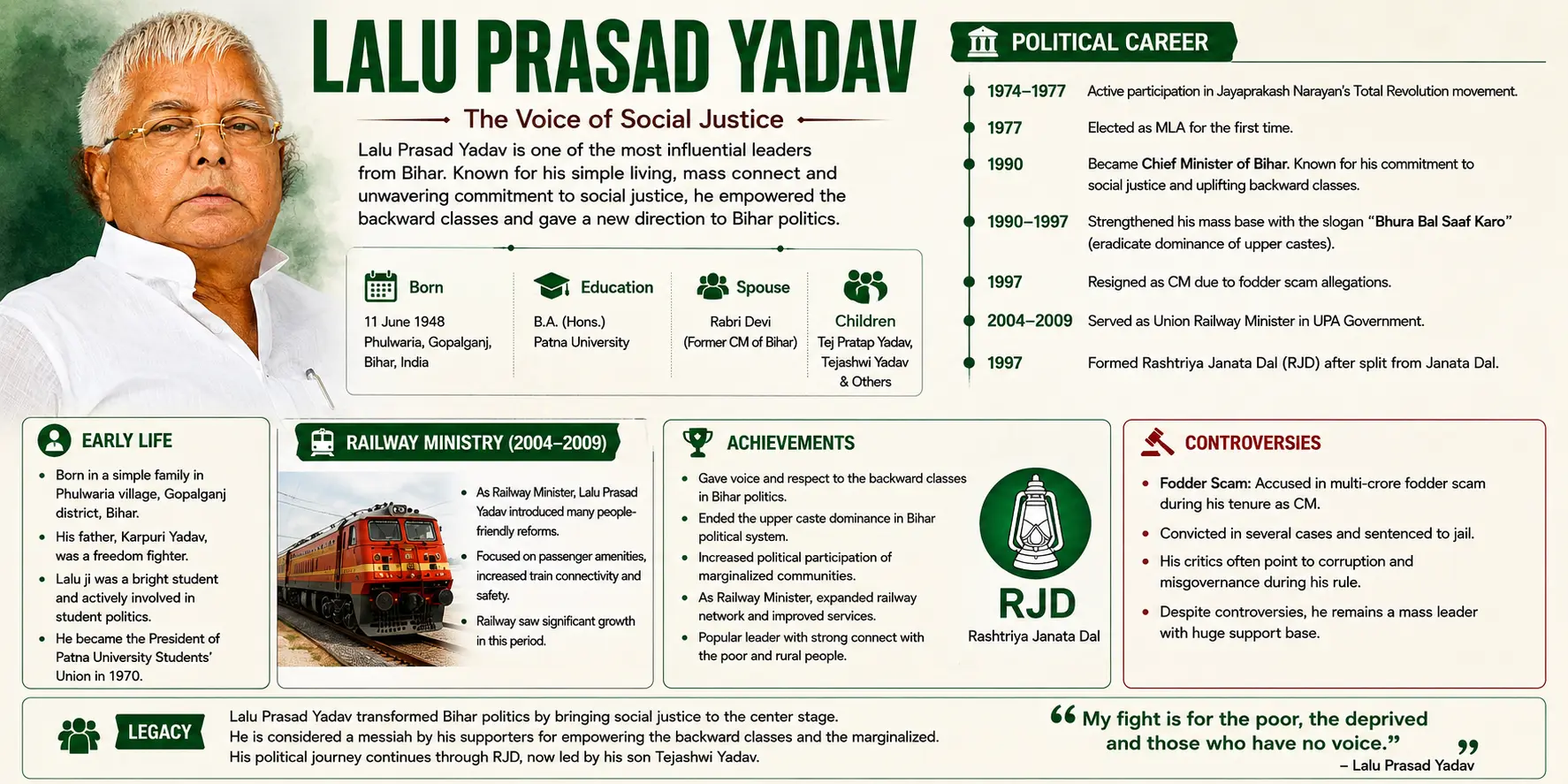
Lalu Prasad Yadav biography and political career is one of the most significant political stories in modern Bihar and Indian politics. Born on June 11, 1948, in Phulwaria, Gopalganj, Bihar, Lalu Prasad Yadav rose from a modest rural background to become the Chief Minister of Bihar and later the Union Railway Minister of India. He became widely known for his politics of social justice, representation of backward communities and secularism. In 1997, he founded the Rashtriya Janata Dal (RJD), which became one of Bihar’s major regional political parties. His career has also included serious controversies and corruption-related convictions, making his political legacy both influential and highly debated.
Who Is Lalu Prasad Yadav?
Lalu Prasad Yadav is an Indian politician, former Chief Minister of Bihar, former Union Railway Minister and founder of the Rashtriya Janata Dal. He is particularly associated with the political rise of backward classes and the social-justice movement in Bihar.
The Lalu Prasad Yadav biography and political career reflects the broader transformation of Indian politics during the 1970s, 1980s and 1990s. During this period, student movements, anti-establishment politics and demands for greater representation created opportunities for leaders from communities that had traditionally held less political power.
Lalu developed a distinctive political style based on direct communication, humour, grassroots mobilisation and social-justice messaging. His supporters viewed him as a leader who challenged established political hierarchies, while his critics raised concerns about governance, administration and law and order.
His career eventually extended from state politics to national politics, including a five-year period as Union Railway Minister.
Lalu Prasad Yadav Early Life and Education
The story of Lalu Prasad Yadav early life and education begins in Phulwaria village in Gopalganj district of Bihar. He was born into a farming family and spent his early years in rural Bihar.
His childhood environment exposed him to the social and economic realities of rural India. Bihar during this period faced widespread poverty, limited infrastructure and strong caste-based social structures.
Lalu later moved to Patna for higher education. He studied at Patna University and completed a Bachelor of Arts with honours and a Bachelor of Laws degree.
His university years became a turning point. He became active in student politics and was influenced by the ideas and political movement associated with Jayaprakash Narayan, popularly known as JP.
The JP movement attracted a generation of young political leaders who later became important figures in Indian politics. Lalu was among those who used the movement as a platform to enter public life.
Early Political Milestones
Lalu’s entry into electoral politics was remarkably quick. In 1977, he was elected to the Lok Sabha from Chhapra at the age of 29.
His first parliamentary victory established him as a young political figure at the national level. He subsequently moved between state and national politics before becoming one of Bihar’s most prominent leaders.
This early phase is an essential part of Lalu Prasad Yadav biography and political career because it explains how a student leader from Bihar eventually reached the highest political office in the state.
Lalu Prasad Yadav Political Career in Bihar
The Lalu Prasad Yadav political career in Bihar became particularly important during the late 1980s and early 1990s.
In 1989, he became Leader of the Opposition in the Bihar Legislative Assembly. His growing popularity among backward classes and other disadvantaged communities strengthened his position in state politics.
In 1990, Lalu Prasad Yadav became the Chief Minister of Bihar.
His election represented a major change in the state’s political structure. His leadership gave greater political visibility to communities that had long demanded stronger representation.
His political message focused heavily on social justice, equality, representation and secularism.
Important Bihar Political Milestones
| Period | Political Development | Importance |
|---|---|---|
| 1977 | Elected to Lok Sabha | Began his major parliamentary career |
| 1989 | Became Leader of Opposition in Bihar | Strengthened his position in state politics |
| 1990 | Became Chief Minister of Bihar | Marked a major shift in Bihar’s political representation |
| 1995 | Returned as Chief Minister | Continued his political dominance in Bihar |
| 1997 | Founded RJD | Created his own major regional political organisation |
| 2004 | Became Union Railway Minister | Expanded his influence to national politics |
| 2009 | Completed Railway Ministry tenure | Ended a major chapter of his national career |
This timeline helps explain why Lalu Prasad Yadav biography and political career is closely connected with the political transformation of Bihar and the rise of regional parties in India.
Lalu Prasad Yadav as Chief Minister of Bihar
Lalu Prasad Yadav served as Bihar’s Chief Minister during a period of significant social and political change.
His administration placed strong emphasis on political empowerment and the representation of backward communities.
One of the defining issues of the period was the implementation of the Mandal Commission recommendations, which increased reservations for Other Backward Classes in government employment.
Lalu strongly supported the politics associated with greater representation for backward communities. This helped him develop a powerful political base among sections of Bihar’s population.
His style of leadership was also different from that of many traditional politicians. He frequently communicated in simple, colloquial language and used humour to connect with ordinary voters.
Social Justice and Political Representation
The Lalu Prasad Yadav contribution to Bihar politics is often evaluated through the social-justice lens.
Supporters argue that his political rise changed the social composition of political power in Bihar. Communities that previously had limited representation became more visible in electoral politics and government institutions.
His approach also included a strong secular political position.
A major event associated with his first chief ministerial period was the arrest of BJP leader L.K. Advani during the Ram Rath Yatra in Bihar in 1990. The incident reinforced Lalu’s image among supporters as a leader opposed to communal politics.
At the same time, critics argue that the emphasis on identity and caste politics came at the expense of development and governance.
Therefore, any balanced discussion of his chief ministerial period needs to acknowledge both the social transformation attributed to his leadership and the criticism directed at his administration.
Lalu Prasad Yadav and Rashtriya Janata Dal History
The Lalu Prasad Yadav and Rashtriya Janata Dal history are inseparable.
In 1997, Lalu Prasad Yadav separated from the Janata Dal and founded the Rashtriya Janata Dal (RJD).
The party was created around themes of social justice and secularism. It soon became one of the most important political organisations in Bihar.
RJD gave Lalu an independent political platform through which he could continue building his political coalition.
The party’s traditional support base has included sections of backward communities and minorities. Over the years, RJD has also formed alliances with other parties, including the Indian National Congress and Janata Dal (United), depending on the political circumstances.
RJD and Lalu’s Political Organisation
The creation of RJD was one of the most important organisational milestones in Lalu Prasad Yadav biography and political career.
| Feature | Significance |
| Founded | 1997 |
| Founder | Lalu Prasad Yadav |
| Main political base | Bihar |
| Core themes | Social justice and secularism |
| Traditional support | Backward classes and minorities |
| Next-generation leadership | Tejashwi Yadav |
The party’s official organisational information currently lists Lalu Prasad Yadav as National President and Tejashwi Yadav as National Working President.
Lalu Prasad Yadav as Railway Minister
One of the most important chapters of Lalu Prasad Yadav biography and political career came when he became Union Railway Minister in 2004.
He served as Railway Minister in the United Progressive Alliance government headed by Prime Minister Manmohan Singh.
His tenure lasted from 2004 to 2009 and gave him a national platform beyond Bihar.
Indian Railways was one of the world’s largest railway networks, making the ministry strategically important. During his tenure, railway finances received significant political and media attention.
Lalu’s supporters highlighted financial improvements, passenger-oriented initiatives and the introduction of services such as Garib Rath.
His tenure also became a subject of discussion in business schools and management circles because of the reported improvement in the financial position of Indian Railways.
However, interpretations of the railway turnaround have differed. Political claims, official financial figures and independent economic analysis should be considered separately when evaluating the performance of his ministry.
Major Railway Ministry Highlights
The main elements associated with his Railway Ministry tenure included:
- Focus on affordable passenger travel
- Expansion of low-cost train services
- Introduction of Garib Rath trains
- Attention to railway finances
- Increased public discussion of railway management
- Greater national visibility for Lalu’s administrative approach
The Railway Ministry period therefore became an important part of Lalu Prasad Yadav biography and political career, especially because it expanded his reputation from a Bihar-based politician to a nationally recognised political leader.
Lalu Prasad Yadav Life History and Achievements
The Lalu Prasad Yadav life history and achievements cover several decades of political activity.
His achievements cannot be measured only by the number of elections he won. His larger influence can be seen in the political changes associated with backward-class representation and regional party politics.
Political Empowerment
Lalu helped make political representation a central issue in Bihar. His rise encouraged greater participation by communities that had historically remained politically underrepresented.
Social Justice
Social justice became the foundation of his political identity. His speeches and campaigns repeatedly focused on equality and representation.
Secular Politics
He positioned himself strongly against communal politics and built political alliances with minority communities.
Regional Party Development
The establishment of RJD demonstrated his ability to create a regional political organisation around a strong ideological and social coalition.
National Political Role
Serving as Railway Minister from 2004 to 2009 expanded his national political profile.
These elements explain why Lalu Prasad Yadav major achievements in politics are still discussed in political science and contemporary Indian politics.
Lalu Prasad Yadav Family and Political Legacy
The Lalu Prasad Yadav family and political legacy have become an important part of Bihar’s political history.
Lalu Prasad Yadav married Rabri Devi, who later served as Chief Minister of Bihar.
Their family has remained politically active for decades.
Among the next generation, Tejashwi Prasad Yadav has emerged as the most prominent political successor associated with RJD. His rise represents an attempt to carry the party’s political identity into a younger generation.
This transition is significant because the future of RJD depends partly on whether the party can preserve Lalu’s traditional social coalition while addressing newer concerns.
Young voters in Bihar increasingly focus on employment, education, migration, infrastructure, entrepreneurship and economic opportunity. A modern RJD strategy therefore needs to combine the historical social-justice message with contemporary governance issues.
Political Succession
The family-based transition has generated both support and criticism.
Supporters see it as continuity of the political movement created by Lalu. Critics describe it as an example of dynastic politics.
Regardless of these different views, the family remains central to the organisational and electoral history of RJD.
Lalu Prasad Yadav Major Achievements in Politics
The Lalu Prasad Yadav major achievements in politics can be summarised through several major milestones.
First, he entered Parliament at a young age in 1977.
Second, he became Chief Minister of Bihar in 1990 and returned to the position after the 1995 election.
Third, he established RJD in 1997, creating a political organisation that continues to play a major role in Bihar.
Fourth, he became Union Railway Minister in 2004 and remained in the position until 2009.
Finally, his politics played a major role in changing the debate around caste representation, social justice and political participation.
Major Career Highlights
| Achievement | Period | Why It Matters |
| First Lok Sabha election | 1977 | Established his national political career |
| Chief Minister of Bihar | 1990–1997 | Led Bihar during a major social-political transformation |
| Formation of RJD | 1997 | Created his own regional political platform |
| Union Railway Minister | 2004–2009 | Gained a major national administrative role |
| Continued RJD influence | 2009–2026 | Remained a central figure in Bihar’s regional politics |
This record shows why Lalu Prasad Yadav biography and political career continues to attract attention among students, political observers and readers interested in Indian history.
Lalu Prasad Yadav Political Journey and Controversies
The Lalu Prasad Yadav political journey and controversies are an essential part of understanding his public life.
The most significant legal controversy surrounding him is the fodder scam, involving fraudulent withdrawals from Bihar’s animal husbandry department.
The cases were investigated over many years and resulted in convictions in multiple matters.
His legal problems significantly affected his political career and resulted in periods of imprisonment.
It is important to discuss these matters accurately because the fodder scam involved several separate cases and court proceedings. A responsible biography should distinguish between allegations, charges, convictions, appeals and final legal outcomes.
The controversy also had organisational consequences for RJD and contributed to a stronger role for the next generation of leaders.
Political Impact of Legal Cases
| Area | Impact |
| Personal politics | Reduced his ability to participate directly in electoral politics |
| RJD | Increased importance of alternative party leadership |
| Public image | Created a major divide between supporters and critics |
| Bihar politics | Became a recurring issue in political campaigns |
| Family leadership | Increased attention on the next generation |
The legal controversies therefore form an important part of the broader Lalu Prasad Yadav political journey and controversies, but they should be discussed alongside his political achievements and social impact rather than treated as the only definition of his career.
Lalu Prasad Yadav Contribution to Bihar Politics
The Lalu Prasad Yadav contribution to Bihar politics can be understood through the transformation of political representation.
Before Lalu’s rise, many communities felt that political power remained concentrated among a limited group of social elites.
His leadership helped change this perception.
He made caste representation and social justice central themes in Bihar’s electoral politics. The political participation of backward communities became more visible.
His style also demonstrated the power of grassroots communication. Instead of relying heavily on formal speeches, he frequently used local language, humour and everyday examples.
This helped him develop a strong emotional connection with supporters.
However, Bihar’s political transformation also produced strong opposition. Critics argued that the state’s economic development and governance performance did not keep pace with its political transformation.
This remains one of the most important debates surrounding his legacy.
Lalu Prasad Yadav Latest Political Role and Influence
The Lalu Prasad Yadav latest political role and influence should be viewed in the context of RJD’s generational transition.
As of 2026, RJD’s official organisational information identifies Lalu Prasad Yadav as National President, while Tejashwi Yadav is listed as National Working President.
This arrangement reflects the importance of Lalu’s continuing authority while giving a younger leader greater organisational responsibility.
Lalu remains a major symbolic figure for RJD supporters. His name continues to carry political significance in Bihar, particularly among communities that identify with his social-justice politics.
At the same time, Tejashwi Yadav has increasingly become the public face of the party’s contemporary political campaigns.
The challenge for the party is to balance historical identity with modern political expectations.
Present Political Significance
| Factor | Current Significance |
| Lalu Prasad Yadav | Historical and organisational authority |
| Tejashwi Yadav | Next-generation leadership |
| RJD | Major regional political force in Bihar |
| Social justice | Core part of party identity |
| Governance | Increasingly important electoral issue |
| Youth voters | Key future political constituency |
This transition is an important part of Lalu Prasad Yadav biography and political career because it shows how his political legacy is being carried into a new era.
Lalu Prasad Yadav’s Leadership Style
Leadership style played a major role in Lalu Prasad Yadav biography and political career.
He developed a highly recognisable communication style that was informal, humorous and direct.
His ability to use local expressions made his speeches accessible to rural voters.
He also had a strong understanding of electoral arithmetic and coalition politics.
His leadership was highly personalised, which helped build loyalty but also created criticism about the concentration of power within the party.
This is particularly relevant when discussing the long-term future of RJD.
A political organisation built around a single charismatic leader eventually needs to develop institutional structures capable of operating across generations.
RJD’s current leadership structure indicates that this generational process is underway.
Why Lalu Prasad Yadav Remains Important in Indian Politics
The significance of Lalu Prasad Yadav biography and political career extends beyond Bihar.
His rise occurred during a period when backward-class politics became increasingly influential across India.
The implementation of the Mandal Commission recommendations created a new political environment. Regional leaders representing backward communities gained greater importance.
Lalu became one of the most recognisable faces of this transformation.
His career also demonstrates how regional political parties can become influential at the national level through coalition governments.
RJD’s participation in national coalition politics gave Lalu an opportunity to influence national policy and parliamentary politics.
His Railway Ministry tenure further strengthened his national profile.
Therefore, his career is relevant not only to Bihar’s political history but also to the development of coalition politics and social-justice movements in India.
Lalu Prasad Yadav’s Political Legacy
The political legacy of Lalu Prasad Yadav is complex.
His supporters emphasise:
- Social justice
- Political empowerment
- Backward-class representation
- Secular politics
- Grassroots mobilisation
- Strong regional identity
His critics emphasise:
- Governance concerns
- Administrative weaknesses
- Infrastructure challenges
- Law-and-order criticism
- Corruption-related legal convictions
- Family-centric party politics
Both perspectives are important for a balanced assessment.
A credible discussion of Lalu Prasad Yadav biography and political career should therefore avoid portraying him as either entirely successful or entirely unsuccessful.
His influence can be measured by the lasting changes he helped bring to Bihar’s political discourse, even where opinions differ sharply about his administration.
Lalu Prasad Yadav in Modern Bihar Politics
Modern Bihar politics continues to reflect many of the political questions that became prominent during Lalu’s rise.
Caste representation remains important, but voters also increasingly evaluate political parties on jobs, education, infrastructure, migration, healthcare and economic development.
This creates a challenge for RJD’s next generation.
The party’s historical social-justice identity remains an important political asset, but contemporary voters also expect practical solutions to everyday problems.
Tejashwi Yadav’s political career is therefore developing within a framework created partly by Lalu’s earlier leadership.
Whether this framework remains electorally effective will depend on how successfully RJD adapts its message to changing voter priorities.
Historical Importance of Lalu Prasad Yadav
From a historical perspective, Lalu Prasad Yadav biography and political career provides an example of how social movements can transform electoral politics.
He emerged from student politics, entered Parliament at a young age, became Bihar’s Chief Minister and later occupied an important position in the Union government.
His career demonstrates the increasing importance of regional leaders in India’s coalition era.
It also shows how caste, class, identity, social justice and electoral strategy interact in a large democracy.
For researchers and students of Indian politics, Lalu’s career offers an important case study in political mobilisation.
Frequently Asked Questions
1. Who is Lalu Prasad Yadav?
Lalu Prasad Yadav is an Indian politician, former Chief Minister of Bihar, former Union Railway Minister and founder of the Rashtriya Janata Dal. He is widely known for his social-justice politics and long-standing influence on Bihar politics.
2. When did Lalu Prasad Yadav become Chief Minister of Bihar?
Lalu Prasad Yadav became Chief Minister of Bihar in March 1990. He served two consecutive terms, with his tenure ending in July 1997.
3. When was Lalu Prasad Yadav Railway Minister?
Lalu Prasad Yadav served as Union Railway Minister from 2004 to 2009. His tenure became particularly well known because of discussions surrounding railway finances and passenger-oriented initiatives.
4. Which political party did Lalu Prasad Yadav establish?
Lalu Prasad Yadav founded the Rashtriya Janata Dal in 1997. The party became one of the major regional political organisations in Bihar and was built around themes including social justice and secularism.
Also read : Lalu Prasad Yadav political journey
: Minister of independent India





Great article, thanks for sharing! For Alibaba Swift-image text to image I recommend Swift-image